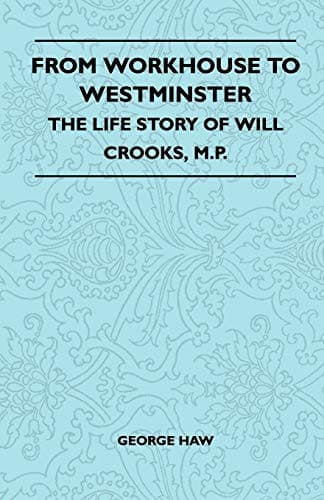
From Workhouse to Westminster: The Life Story of Will Crooks, M.P.Haw, George
History
From Workhouse to Westminster: The Life Story of Will Crooks, M.P.
Haw, George
Crooks, William, 1852-1921; Legislators -- Great Britain -- Biography; Social reformers -- Great Britain -- Biography
Yes, they need "homes," indeed, these wayward youngsters, ensnared by
the temptations of London's streets. Some are here for gambling in the
gutter, many for playing truant, some for sleeping out, and others for
felony. Generally they are sent home if it be a first offence, or to a
reformatory if the case be a bad one.
There are girls here, too. What of them?
"Me and my sister was taken up by the police for sleeping on a
doorstep," said one sad-eyed little maid in a blue frock.
"Why on a doorstep?"
"Father left us, and when mother died the landlord turned us out."
True enough, and the sisters will be sent to a girls' home shortly.
That is the best that can be done for the girls, especially the large
number that are brought away from houses of ill-repute.
The boys who get committed to reformatories still find themselves under
Crooks's eye. While the Asylums Board looks after them when under
remand, the London County Council becomes responsible once the lads are
committed. This dual control Crooks is trying to get rid of, in the hope
that the duty will be given wholly into the hands of one authority.
For several years he was a member and at one time Chairman of the L.C.C.
Committee that looks after the industrial and reformatory schools. The
committee meets at Feltham, where is the largest of the institutions
under its charge. It was rare for Crooks to be absent during his
membership of the committee.
He and Colonel Rotton, who was also Chairman for a period, could
generally make the lads on arrival understand them without much
parleying. Every lad, on being committed to the school by a magistrate,
had to appear before the committee. Here are some characteristic
dialogues:--
"Well, my boy, what are you here for?"
"Burglary." The burglar was nine years of age.
"Well, you can't be a burglar here, but you can be a good lad. Everyone
can be a good lad here if he likes. If he doesn't like we make him. What
will you do?"
"I fink I'll like, sir."
Generally the lads do not admit their offence so readily. They are not
always so frank as you find them in the Remand Homes. Most of them, when
before the Committee, find excuses, like the boy who was caught with
others stealing in a railway goods yard.
"Please, sir, it weren't me at all."
"We always get the wrong boy. What are you supposed to be here for?"
"Fieving, sir. But I didn't do it. I were on'y sitting on the fence."
"Then let this be a lesson to you. Never sit on the fence. Do you know
the Ten Commandments?"
"No, sir."
"Can you say the Lord's Prayer?"
"No; we wasn't taught it at the school wot I used to go to."
"But you didn't go to school."
"The boy wot did go told me."
"Well, we'll see to it that you do go to school now."
Public-domain text, read in full here on John Shaqi.
Reviews
Reviews
No reviews yet
Be the first to share your thoughts on this work.
Elsewhere in the archive
Join the Discussion
Join the discussion
Sign in to leave a comment or review.
Sign InorCreate an account