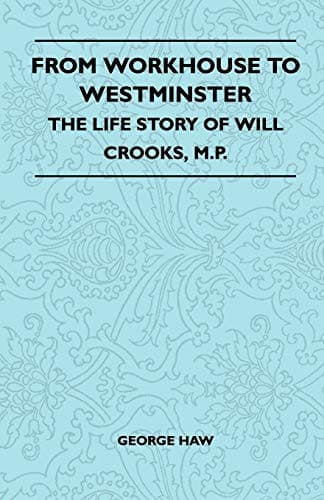
From Workhouse to Westminster: The Life Story of Will Crooks, M.P.Haw, George
History
From Workhouse to Westminster: The Life Story of Will Crooks, M.P.
Haw, George
Crooks, William, 1852-1921; Legislators -- Great Britain -- Biography; Social reformers -- Great Britain -- Biography
Another new-comer excused himself more ingeniously:--"Me and my mate we
found a donkey and barrer at Covent Garden. We saw a man's name on the
barrer, and fought if we went off wif the donkey we would git a shilling
the next day for taking it back to him. But a copper stopped us as we
was leading the donkey over Waterloo Bridge. So we hadn't a chance to
take it back, as we was going to."
"Very well, you must stay with us until you learn that donkeys in
barrows are not necessarily lost."
Crooks believed in giving the boys plenty of play and plenty of work.
Nearly all their offences he believed to be due to excess of vitality.
They had never had a chance of working it off in a proper way before.
Besides, many of the lads needed mothering. It was always his regret
that he could not persuade his colleagues on the Committee to adopt a
system he found in vogue in the Moss Hill industrial school in Glasgow.
When visiting that institution he was agreeably surprised to find about
a dozen "mothers" on the staff. If a lad tore his coat or pulled off a
button, he knew which particular "mother" to run to in order to be
patched up.
"I have always said, and shall always continue to say," he states, "that
reformatory schools ought to be made a State charge entirely. If there
is any part of the community that can be called a national debt, it is
this class of poor, misguided lads who, if they were properly cared for,
would soon become a valuable national asset."
CHAPTER XVIII
PROUD OF THE POOR
The Handy Man of Poplar--Peacemaker among his Neighbours--Piloting
the Author of "In His Steps" through the Slums--Difference between
a Street Arab and a Prince--Object Lesson for a Professor of
Political Economy--How the Poor help the Poor.
During these years the saying grew up among his neighbours that nothing
happens in Poplar without someone running to Will Crooks about it. His
little house at 28, Northumberland Street, to the north of East India
Dock Road, was the gathering ground of all kinds of deputations and of
troubled individuals seeking advice on every subject under the sun. He
was a court of appeal in family troubles as well as on public questions.
A small girl came to the door one night with the announcement:
"If you please, father's took to drink again, and mother says will Mr.
Crooks come round and give him a good hiding?"
Appeals like that of an old labourer who could neither read nor write
became common. The old man stood sobbing on the step without a word when
Crooks's youngest daughter opened the door. Instinct told her it was her
father that was wanted, and she called him.
"Well, old Charley, what's the matter now?" when Crooks recognised his
caller.
"She's turned me out again," came the words between sobs. "If you would
on'y go and speak to her, Mr. Crooks, and put in a word for me! She
ain't half a bad wife, you know. It's on'y her temper and me as don't
agree."
Public-domain text, read in full here on John Shaqi.
Reviews
Reviews
No reviews yet
Be the first to share your thoughts on this work.
Elsewhere in the archive
Join the Discussion
Join the discussion
Sign in to leave a comment or review.
Sign InorCreate an account