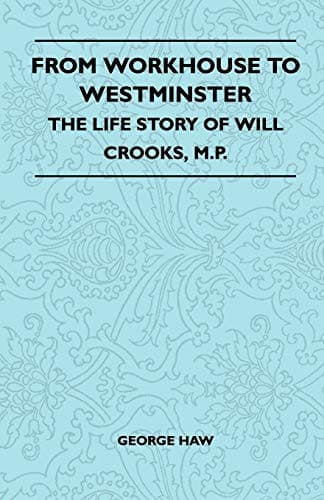
From Workhouse to Westminster: The Life Story of Will Crooks, M.P.Haw, George
History
From Workhouse to Westminster: The Life Story of Will Crooks, M.P.
Haw, George
Crooks, William, 1852-1921; Legislators -- Great Britain -- Biography; Social reformers -- Great Britain -- Biography
"A very wealthy man who owns a lot of small houses in Poplar had his
attention called to the hardship inflicted by the heavy increase in
rents. He was told that a widow whose rent had just been doubled would
have to seek parish relief if the new demand were enforced. 'My dear
good fellow,' said the owner, 'I leave these matters to my agent. I
don't want the woman's money. Look here,' pulling a handful of
sovereigns out of his pocket. 'Why should I care about the woman's rent?
I leave these trifles to my agent, and never interfere.'
"Can you wonder that so many of our people are driven to drink and
immorality?" Crooks went on after telling this incident. "Sweated as
they are for rent in this way, they begin to live in an unholy state of
overcrowding. House speculators, Jewish and English, gamble with the
people's homes. Nearly every time a house changes hands the rent is
raised. The overcrowding is thus made worse than ever. The family living
in three rooms takes two. The family in two rooms pushes its furniture
closer together and goes into one.
"Surely something should be done by the State to prevent this gambling
with poor people's rents. I would like to see Fair Rent Courts, where
the rents could be fixed in fair proportion to the value of the house.
Something of the kind has been done in Ireland; why not in England?
"One thing is certain: the more crowded the home is, the more convenient
becomes the public-house, with its welcome light and deceptive
cheerfulness tempting the wretched. Of course, in theory it is easy to
argue that the poorer the man the more reason there is that he should
not place in the publican's till the money that ought to be spent on
food. I fear few of us would retain the moral courage to resist if we
had to eat, live, and sleep in the same room, sometimes in the company
of a corpse for several days."
Property owners were not alone in their opposition to the Labour Mayor.
The publicans almost in a body were ranged against him. Nor was this
only because of his uncompromising attack on the drink interests as
such. It was mainly because he insisted on public-houses being rated on
the same principle as the grocer's shop or the working-man's
dwelling-house.
For several years before his mayoralty he had been Chairman of the
Poplar Assessment Committee. He found that while small tradesmen and
householders were rated to the full market value of their shops and
dwellings, public-houses were very much under-assessed. He therefore
persuaded the Committee, in face of all that the publicans said and
threatened, to raise their assessments to the proper scale. The
publicans brought the whole strength of their organisation against him,
briefing counsel in appeals and subsidising opposition candidates at the
local elections. This kind of thing had no fears for Crooks. His policy
prevailed.
Public-domain text, read in full here on John Shaqi.
Reviews
Reviews
No reviews yet
Be the first to share your thoughts on this work.
Elsewhere in the archive
Join the Discussion
Join the discussion
Sign in to leave a comment or review.
Sign InorCreate an account