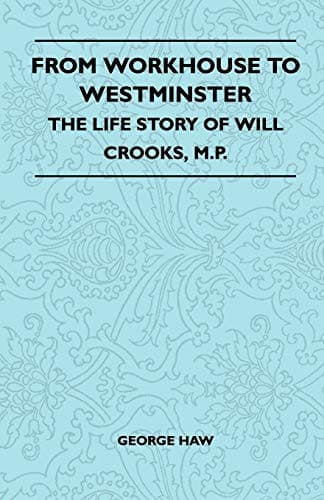
From Workhouse to Westminster: The Life Story of Will Crooks, M.P.Haw, George
History
From Workhouse to Westminster: The Life Story of Will Crooks, M.P.
Haw, George
Crooks, William, 1852-1921; Legislators -- Great Britain -- Biography; Social reformers -- Great Britain -- Biography
Sorely though the problem of housing vexed him, he rarely came away from
a slum visit without some instance of quaint humour. On one occasion he
was called into a tenement when the woman told him to mind the hole in
the floor.
"Why don't you ask the landlord to repair it?" he asked.
"I did tell him about it," she answered in despair, "but he only said,
'What! the floor fallen in? Why, you must have been walking on it!'"
He feels keenly that we are allowing the English working-class home to
be broken up by the gambling of speculators. By the time the gamblers
are finished, it will be found they have broken more than the poor man's
home. It will be found they have broken the English race.
The cost to the municipality of preventing the existence of slums is
small, he maintains, compared with the cost to the Poor Law authority of
dealing with the human wreckage that slums create. He brought out this
fact in a striking way in a paper he read before the Central Poor Law
Conference at the Guildhall. His subject was "Pauperism and
Overcrowding." He estimated from a study of the official returns that
overcrowding and insanitation in the homes of the poor threw an
additional expenditure on the Poor Law every year in London of about
£134,000. He obtained this figure by estimating the number of people
forced into workhouse infirmaries or requiring the outside attendance of
the parish doctor owing to sickness solely caused by slumdom.
As regards the inmates of public asylums, he showed that London was
involved in a still heavier yearly outlay. The number of such inmates
per thousand inhabitants of London varied from 1.9 in the healthy
districts to 10.1 in the overcrowded districts. The mean rate was 4.7.
The numbers above this mean rate were all found in the slum quarters. By
adding them up he arrived at a total of 2,700 people who were forced
into asylums as the results of ill-housing. It cost London £70,000 a
year to maintain this number in asylums. He further argued that an
additional sum of half a million sterling must be put down as
representing the cost of providing the necessary asylum accommodation
for these 2,700 inmates, the creation of our slums.
"So if the public refuse to spend a few hundreds on improving the homes
and conditions of the poor, they are compelled to spend tens of
thousands after the slums have robbed their denizens of health and
reason. I know some of the poor do not live the cleanest and best lives.
They live down to their environment. And if we don't improve the
environment, then, apart from all the higher considerations, we are
penalised for our neglect by having to pay for their care and keep in
asylums and infirmaries.
"We Labour men are sometimes accused of crying for the moon. No; we are
crying for the sun, and before we are finished we mean to get a little
more sun into the homes and hearts of the people."
CHAPTER XX
THE KING'S DINNER--AND OTHERS
Public-domain text, read in full here on John Shaqi.
Reviews
Reviews
No reviews yet
Be the first to share your thoughts on this work.
Elsewhere in the archive
Join the Discussion
Join the discussion
Sign in to leave a comment or review.
Sign InorCreate an account