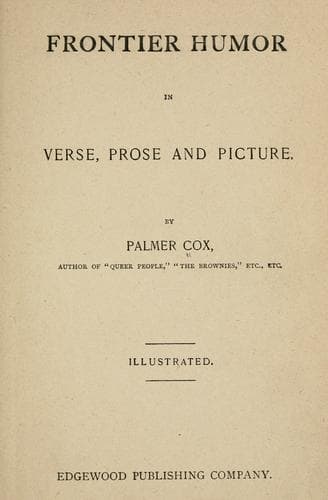
Frontier Humor in Verse, Prose and PictureCox, Palmer
General
Frontier Humor in Verse, Prose and Picture
Cox, Palmer
Canadian wit and humor
’Twill be all the same in a thousand years!
What a terrible line this, to draw out the tears.
Oh, how oft do I weep at the dance, or the play,
O’er the sorrows we women are doomed to convey;
And can it be so, must we stand at the gate,
Denied all the honors of the country or State?
Our part but to please and obey lordly man;
Be kind when he’s surly, and be sweet as we can;
As students to shiver, like leaves in the breeze,
If we chance to infringe on his rules or decrees?
Then have pity, ye gods, who look down on our case,
Shut from Bar, Bench and School Board, and every fat place,
To pick up the pennies that oppressors fling down,
For cutting and stitching, and clothing the town.
Oh, the tyrant’s sharp lash, his “pooh pooh’s,” and his sneers,
Will be all the same in a thousand years.
Ah! ’tis not the same in a thousand years;
How sweet and how pleasant our life now appears,
For women no longer bow down at the nod
Of creatures, who ruled with a chain and a rod;
But as lawyers they plead, and as doctors dissect,
And in temples of learning control and direct.
The weak-footed student at mile-posts may rest
Without springing a mine in the President’s breast;
There’s no splitting of hairs to deny her the prize,
She receives her diploma and a blessing likewise;
Now women no more stitch and stew for their lives,
Or suffer injustice, because daughters or wives;
Lo, they sit down as jurors, they judge and they vote,
And in steering through life ply an oar in the boat.
The mother departed looks down here with pride
On her merciful child dealing charity wide;
While man, that once governed so harsh and severe,
Applies for positions in meekness and fear;
Now the cane of the dude is no more on the street,
The eyeglass is missing, and sharp-pointed feet,
The poor “chappy” himself is beyond the bright spheres,
For ’tis not the same in a thousand years.
[Illustration]
THE COBBLER’S END.
A large crowd of people was standing in and around a small shoemaker’s
shop on Third Street. Elbowing my way to the inner circle, I found the
excitement was over a man who had committed suicide. He was lying upon
the floor, his hands still grasping a shot gun, with which he had blown
off the top of his head.
I learned it was the shoemaker, and that he had committed the rash act
because the lady on whom his affections were set had seen fit to choose
another for her partner. Worst of all, it was a tailor who, to use a
common expression and one to the point, had cut him out. They were both
charmed with the comeliness of the young woman, and whenever an
opportunity offered, were in the habit of throwing sheep’s eyes in the
direction of her apartment. The lady seemed to grow more interested in
the situation, and even went so far as to smile archly upon him.
Public-domain text, read in full here on John Shaqi.
Reviews
Reviews
No reviews yet
Be the first to share your thoughts on this work.
Elsewhere in the archive
Join the Discussion
Join the discussion
Sign in to leave a comment or review.
Sign InorCreate an account