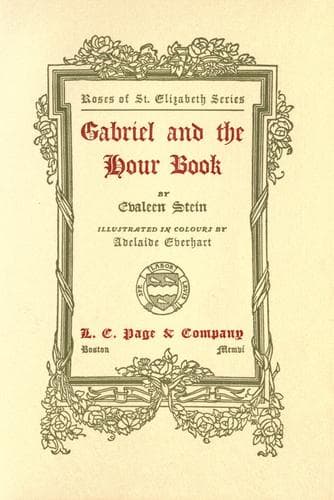
France -- History -- 15th century -- Juvenile fiction; Illumination of books and manuscripts -- Juvenile fiction
At first Brother Stephen was rather displeased; for he did not like it
that the little boy had begged of the Abbot something which he himself
was too proud to ask. But when he thought it over, and reflected that it
was out of sheer kindness that Gabriel had made the request, his heart
strangely warmed toward the lad. Indeed, through all his life in the
Abbey, no one had ever really cared whether he was happy or unhappy; and
so poor Brother Stephen had had no idea how very pleasant it would be
to have even a little peasant boy take an interest in him. And as day
after day went by, he began to love Gabriel, as he had never before
loved any one.
Yes, those were very happy days for both of them, and very busy ones,
too. Every morning Gabriel would come to the Abbey with his hands filled
with the prettiest wild flowers he could find on the way; and from these
Brother Stephen would select the ones that pleased him best to paint.
Sometimes it would be the sweet wild hyacinths of pale blue, sometimes
the yellow marsh-marigolds, and again the little deep pink field-roses,
or some other of the innumerable lovely blossoms that every season
brought. And with them all, as he had said, he put in the small flying
creatures; butterflies and bees, scarlet ladybugs and pale green
beetles, whose wings looked like scraps of rainbows; and sometimes, in
his zeal, he even painted the little snails with their curled-up shells,
and the fuzzy caterpillars that happened to come in on Gabriel's
bouquets, and you really would never believe how very handsome even
these looked in the gold borders, when Brother Stephen got through with
them.
And so, day by day, the book grew in perfect beauty. And as Brother
Stephen worked, there was much for Gabriel to do also. For in those days
artists could not buy their ink and paints all ready for use as they do
to-day, but were obliged to prepare by hand almost all their materials;
and a little assistant such as Gabriel had to keep his hands busy, and
his eyes open, too.
For instance, the matter of the ink alone, Gabriel had to have on his
mind for weeks; for one could not then buy it ready made, in a bottle,
as we do now without the least trouble, but the monks or their
colour-grinders had to make it themselves.
And this is the way Gabriel had been taught to do it: morning after
morning of those early spring days, as he trudged along on his way to
the Abbey, he kept sharp watch on the young hawthorn-trees by the
roadside; and when their first buds showed, and while they were still
tiny, he gathered armfuls of the boughs, and carried them to the Abbey,
where he spread them out in a sunny corner of the courtyard to stay
until quite dry. Then he had to put them in a stone mortar and pound off
all the bark; and this he put to steep in great earthen jars of water,
until the water might draw all the sap from out the bark. All this took
several weeks to do.
Public-domain text, read in full here on John Shaqi.
Reviews
Reviews
No reviews yet
Be the first to share your thoughts on this work.
Join the Discussion
Join the discussion
Sign in to leave a comment or review.
Sign InorCreate an account