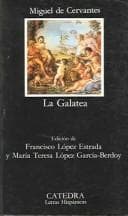
Spanish fiction -- Translations into English; Spanish poetry -- Translations into English
Galatea and Florisa embraced her, and offered her their friendship
anew, and to serve her to the best of their power. Meanwhile Galatea's
father and the other shepherds, having spread their cloaks on the
margin of the clear stream, and drawn from their wallets some country
fare, invited Galatea and her companions to eat with them. They
accepted the invitation, and, sitting down forthwith, they sated their
hunger, which was beginning to weary them as the day was already far
spent. In the course of these doings, and of some stories the shepherds
told to pass the time, the accustomed hour approached for returning
to the village. Straightway Galatea and Florisa, returning to their
flocks, collected them once more, and, in the company of fair Teolinda
and the other shepherds, gradually made their way to the hamlet; and at
the break of the hill where that morning they had happened on Elicio,
they all heard the pipe of the unloving Lenio, a shepherd in whose
breast love could never take up his abode; and thereat he lived in such
joy and content, that in whatever converse or gathering of shepherds he
found himself, his sole intent was to speak ill of love and lovers, and
all his songs tended to this end. By reason of this strange disposition
of his, he was known by all the shepherds in all those parts, and by
some he was loathed, by others held in esteem. Galatea and those who
came there stopped to listen, to see if Lenio was singing anything,
as was his wont, and straightway they saw him give his pipe to a
companion, and begin to sing what follows to its sound:
LENIO.
An idle careless thought that wanders free,
A foolish vaunting fancy of the mind,
A something that no being hath nor kind,
Nor yet foundation, nursed by memory,
A grief that takes the name of jollity,
An empty hope that passes on the wind,
A tangled night where none the day may find,
A straying of the soul that will not see.
These are the very roots wherefrom, I swear,
This old chimera fabled hath its birth,
Which beareth o'er the world the name of Love.
The soul that thus on Love doth set its care,
Deserveth to be banished from the earth,
And win no shelter in the heavens above.
At the time that Lenio was singing what you have heard, Elicio and
Erastro had already come up with their flocks in the company of the
hapless Lisandro; and Elicio, thinking that Lenio's tongue in speaking
ill of love went beyond what was right, wished clearly to show him his
error, and, adopting the very theme of the verses he had sung, at the
moment Galatea, Florisa, Teolinda and the other shepherds came up, to
the sound of Erastro's pipe he began to sing in this wise:
Public-domain text, read in full here on John Shaqi.
Reviews
Reviews
No reviews yet
Be the first to share your thoughts on this work.
Elsewhere in the archive
Join the Discussion
Join the discussion
Sign in to leave a comment or review.
Sign InorCreate an account