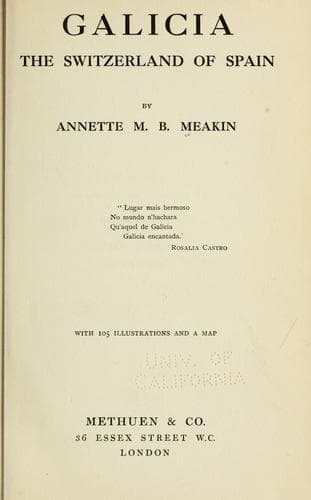
Galicia, the Switzerland of SpainMeakin, Annette M. B.
History
Galicia, the Switzerland of Spain
Meakin, Annette M. B.
Galicia (Spain : Region)
Santiago from analogous works,--he knows of no other such; the whole
subject is usually limited to the tympanum of one arch.[154] He also
points out that Lopez Ferreiro is mistaken in thinking that the Christ
in the cathedral of Autun has wounded hands outstretched in blessing,
and a bare breast showing a wound,--the arms of that statue are not
raised, and the breast is covered, so that no wounds are seen.
A clustered pillar composed of six granite columns, with a richly carved
capital, separates the two entrances beneath the tympanum of the central
arch. This pillar rests its base on the back of the figure of a man
lying on his stomach with head and shoulders raised above a scroll, the
writing upon which has been effaced. His arms are extended over the
backs of two lions with huge gaping jaws. Beneath the capital of this
column is a large seated figure of St. James, the “Son of Thunder,” the
patron saint of Santiago di Compostela, and in fact the patron saint of
the Spanish Peninsula. St. James, larger than life, is seated in an
armchair, the feet of which are supported by two little lions. Round the
saint’s head is a nimbus studded with crystals and other stones,--very
Byzantine in appearance, and supposed to be of much more recent date
than the sculpture. St. James holds in his left hand a staff the handle
of which is shaped like the letter T,[155] and in his right he holds a
parchment scroll on which we read “Misit me Dominus.” The lions, and the
chair in which St. James is seated, rest upon the beautifully carved
capital of a slender marble[156] column, the whole fust, or shaft, of
which is covered with delicate bas-reliefs illustrating the Stem of
Jesse. The idea was first suggested by Jerome in the fourth century: in
this representation of it there are seven human figures. Jesse lies at
the foot, while out of the heart there grows a tree which wraps in its
foliage the seated figure of King David, with his crown and musical
instrument, and between his knees the stem passes; above him is King
Solomon, also enfolded in the leaves, and above King Solomon is seated
the Virgin Mary, not concealed or shaded by any leaves, but rising out
of the tree, as though she (who was believed to be born without sin)
were its perfect flower. Above her delicate profile on the capital of
the same marble column is sculptured a representation of the Holy
Trinity. The Holy Spirit in the form of a dove is appearing from a
cloud; below is seated the Almighty with a mantle round His shoulders
and a royal crown upon His head, pointing to His Divine Son, whose arms
are extended on a cross. Four angels, two on either side, are engaged in
adoration of the Holy Trinity. This way of representing the Trinity,
according to Sanchez, is very ancient: it fell into disuse centuries
ago, because the ignorant crowd used to mistake it for the Coronation of
the Virgin.
Public-domain text, read in full here on John Shaqi.
Reviews
Reviews
No reviews yet
Be the first to share your thoughts on this work.
Elsewhere in the archive
Join the Discussion
Join the discussion
Sign in to leave a comment or review.
Sign InorCreate an account