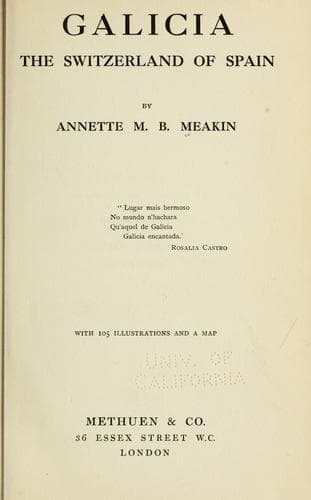
Galicia, the Switzerland of SpainMeakin, Annette M. B.
History
Galicia, the Switzerland of Spain
Meakin, Annette M. B.
Galicia (Spain : Region)
For centuries poor women from all parts of Spain and Portugal have
implicitly believed that by placing their right hand where the branches
of the Tree of Jesse are thickest, and praying at the same time that God
will grant them children, they will receive the desired end. At the spot
where so many thousands of hands have been placed the marble is
literally worn away, like the toe of St. Peter at Rome. Priests shake
their heads at this superstition, but the women’s faith is not shaken,
and the custom continues to be practised.
The Tree of Jesse has often been used to represent the genealogy of
Christ. Parker tells us that it was by no means an uncommon subject for
sculpture, painting, and embroidery. At Dorchester Church, Oxfordshire,
it is curiously formed in the stone-work of one of the chancel windows.
At Christchurch, near Bournemouth, it is chiselled in stone on the
reredos of the altar; the figure of Jesse is here much larger than life
size, and the whole thing is larger in proportion; in this case the tree
springs from the loins of Jesse, not from his heart, as at Santiago. The
same subject is introduced in a painted window at Chartres; also in one
at Rouen.[157]
In a line with the statue of St. James, and the same height from the
ground, upon other sculptured columns with their backs to the great
piers which support the arches of the narthex, are grouped the
startlingly life-like figures of a number of evangelists and prophets,
each of which deserves the most careful study. The names of most of them
are indicated by the writing on their scrolls, or by some unmistakable
token. St. Peter, for instance, holds the keys, and is the only one
wearing pontifical dress; he represents the Head of the Church. St. Paul
holds a book, in which we can read the opening words of the Epistle to
the Hebrews. St. James the Elder, again represented, holds a scroll on
which we read, “_Deus autem incrementum dedit in hac regione_.” St.
John, the brother of St. James, is known by his sweet juvenile face, and
by the eagle which supports him. He has the Apocalypse open at the page
_Vidi civitatem sanctam_, etc., and appears to be reading it. There is
some doubt as to who the four next to him are meant to represent; after
them, on the eastern side, comes _St. John the Baptist_ holding in his
hands the _Agnus Dei_. Next is the figure of a woman with a crown, whom
some take for Queen Urraca, niece of Pope Calixtus II., and others for
Catherine of Leon. The most modern theory about this figure is that she
is intended to represent Judith; Judith’s appearance among the prophets
and evangelists in the _Pórtico de Gloria_ is taken to be a proof that
in the twelfth century the Book of Judith was included amongst the
canonical books of the Old Testament. Dr. Eladio Oviedo tells me,
moreover, that this belief is supported by many passages in the books of
the twelfth, thirteenth, and fourteenth centuries. There is also a
Public-domain text, read in full here on John Shaqi.
Reviews
Reviews
No reviews yet
Be the first to share your thoughts on this work.
Elsewhere in the archive
Join the Discussion
Join the discussion
Sign in to leave a comment or review.
Sign InorCreate an account