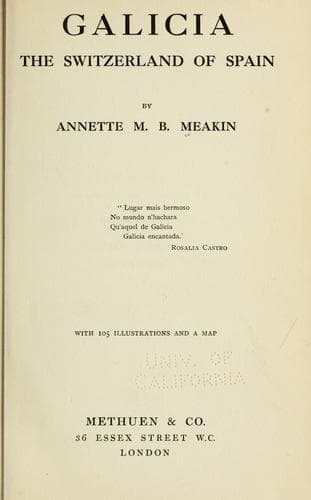
Galicia, the Switzerland of SpainMeakin, Annette M. B.
History
Galicia, the Switzerland of Spain
Meakin, Annette M. B.
Galicia (Spain : Region)
The north-west cloister and the north-east cloister are both adorned
with Doric columns, but in the case of the upper storey it is of later
date and does not correspond with the lower. Both these cloisters have
fountains enclosed in elegant Gothic miniature temples, _templetes_ with
arches, columns, and pinnacles. We passed on to the south-east cloister
through a small passage with elegantly decorated doors: this one is
separated from the last by the eastern transept of the chapel; it is
more like the first cloister than the other two, with its fountain, its
bronze statue, and its handsome granite basin, all of which attracted
our attention. We noticed its pretty doorways leading to the kitchen and
the dispensary, and the smaller doorway leading to the vestry, all of
these were ornamented with _plateresque_ tracery.
The chapel occupies the centre of the building, and is in the form of a
Latin cross, with a shortened head, so often found in churches of the
last decade of the fifteenth and in the early years of the sixteenth
century; the shortened head is the sacristy. The most interesting
portion of this chapel is its transept, which is separated from the nave
by a strikingly artistic railing of beaten iron which, like the one in
the portico of the hospital, is the work of Master Guillen: on it we
distinguish the Arms of Spain, the Imperial Eagle, and the scallop shell
of St. James. Sanchez says of the transept: “It is in the Gothic style
peculiar to the architecture of Galicia”; and then he complains bitterly
of the barbaric coating of whitewash which covers the beautiful granite
vaulting, the balustrades, and the finely sculptured columns. Spanish
architects divide the Gothic style into three periods, and it is to the
third or last of these that the architecture of this chapel belongs,
while its ornamentation is _plateresque_. In all its lines and in all
its component parts there exists the most perfect harmony and the most
correct composition imaginable; it is consequently a very beautiful
example of the transition epoch, in which the florid elements of the
Gothic style mingled with those of the _plateresque_ to form, as it
were, a new style of architecture. In describing it thus I am not
venturing to give a new and unauthorised opinion, I am simply repeating
a truth that has been endorsed by every _connoisseur_ who has had the
privilege of visiting this beautiful little chapel.
Entering the chapel by the door from the first cloister we note a
graceful font for consecrated water, very shallow, and supported by a
slender pedestal--it is enriched with Gothic moulding. Ancient fonts
were always large enough to allow for the immersion of infants; this one
probably dates from the end of the fifteenth century, and its sculpture
is of the same class as that of other parts of the chapel. The beaten
iron candelabra is also good work, though gilded and silvered in a
tasteless manner.
Public-domain text, read in full here on John Shaqi.
Reviews
Reviews
No reviews yet
Be the first to share your thoughts on this work.
Elsewhere in the archive
Join the Discussion
Join the discussion
Sign in to leave a comment or review.
Sign InorCreate an account