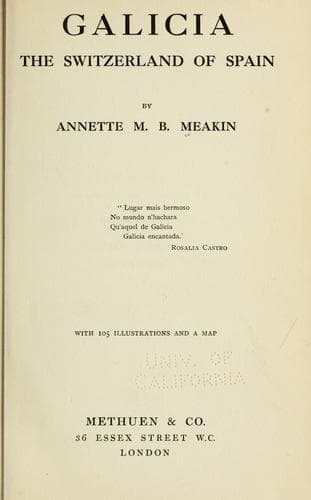
Galicia, the Switzerland of SpainMeakin, Annette M. B.
History
Galicia, the Switzerland of Spain
Meakin, Annette M. B.
Galicia (Spain : Region)
This _Colegiata_ was founded by Muñio, Bishop of Mondoñedo, one of the
authors of the _Historia Compostelana_, who in his old age wished to
retire with a few aged companions (canons of the cathedral) to some
peaceful spot where he might end his days in prayer and meditation. He
built a church and hermitages for himself and his companions, and lived
there quietly for some years; then, when he felt death approaching, he
handed the whole property over to Archbishop Gelmirez, that it might be
made into an Augustine monastery. The whole story may be read in the
ancient documents still preserved. The letter signed by Diego Gelmirez
on September 1, Era 1174 (1137), and confirmed by Alfonso VII., is one
of the most interesting of the diplomatic documents contained in the
rich archives of the monastery. When in 1235, a century later,
Archbishop Bernard renounced his mitre, he retired to end his days in
the monastery of Sar, where his roughly hewn sarcophagus and his
recumbent stone statue are still to be seen; the traveller will find it
by the wall between the right apse and the door of the sacristy. The
statue has a long beard,[176] which is rather unusual, a mitre, a long
staff decorated with scallop-shells, with a _tau_ handle. In 1711 this
sarcophagus was opened by order of Archbishop Monroy, and the body was
found well preserved and the garment on it in good condition, according
to Zepedano, whom Villa-Amil quotes as a reliable authority. On the
outer side of the sarcophagus are carved the following leonine verses,
in two lines, one above the other:--
“Transit ab hoc vita Bernaldus Metropolita
Post hoc vile solum scandire posse polum.”[177]
Bernard died on November 20, 1240, as we learn from an inscription in
five lines on the head of the sarcophagus (the date of the era is
given). Such was the odour of sanctity in which he died that when the
sarcophagus was opened several of his teeth were extracted as relics,
also part of his staff and some fragments of his dress. Villa-Amil has
carefully examined these last and compared them with others of the same
epoch preserved in the Cluny Museum. He concludes that the material of
one of St. Bernard’s garments was Moorish in design and texture.
At the other end of the church is another granite tomb, that of Don
Gomez Gonzalez, the prior in whose day the greater part of the present
vaulting was added. The body of his successor and cousin, Jacome
Alvarez, lies between two of the columns that support the eastern
vaults, in a sarcophagus which Alvarez had prepared for himself during
his lifetime and mentioned in his will. Sanchez gives the whole clause
in his description of the _Colegiata_. There are also many interesting
inscriptions on the old pavement stones of the aisles, now mostly
covered with water.
Public-domain text, read in full here on John Shaqi.
Reviews
Reviews
No reviews yet
Be the first to share your thoughts on this work.
Elsewhere in the archive
Join the Discussion
Join the discussion
Sign in to leave a comment or review.
Sign InorCreate an account