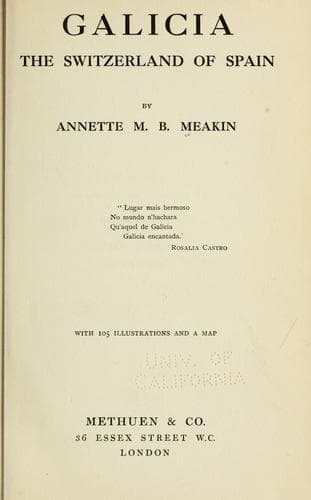
Galicia, the Switzerland of SpainMeakin, Annette M. B.
History
Galicia, the Switzerland of Spain
Meakin, Annette M. B.
Galicia (Spain : Region)
Part of the original cloister of the monastery is still standing, the
northern front. Nine delicate and richly sculptured Romanesque arches
and two keystones of the vaulting are still in their place; they rest
upon piers ornamented with pairs of slender columns whose capitals are
decorated with sculptured foliage, very full and natural, and every one
different. The bases of the columns rest upon plinths. This remnant of
the cloister is considered to be one of the most perfect bits of
mediæval architecture in Galicia. The rest of it is modern, and dates
from about the end of the eighteenth century. In the north-east angle is
a fine granite sarcophagus of another prior, whose recumbent statue in
full sacerdotal robes has both hands holding a book upon his breast; it
dates from the year 1368.
The monastery, which was entirely rebuilt in the eighteenth century, is
now the home of the parish priest, as the church is now the parish
church of Sar. The Churrigueresque belfry was put up when the original
façade of the church was spoiled by the addition of the elliptical
arches. My guide pointed out to me two slender columns, evidently part
of the old cloister, which are now placed on either side of the rectory
door. He also showed me, in the church, an old wooden bench, eaten with
age, with the Arms of the Inquisition stamped upon it, a cross with a
palm leaf on its right and a sword on its left.
A hospital, chiefly for canons afflicted with elephantiasis, _Hospital
de San Lazaro_, was founded in connection with this monastery in 1149,
and had dwelling-houses attached to it, _sustentari possint elefantiosi
canonici_.[178] The prior of Sar was expected to take the inmates of
this hospital under his spiritual care. There is in Santiago to this
day a special hospital for that class of disease, and it attracts
patients from all parts of the province. I have heard it remarked that
on this account visitors should be careful in their selection of inns
and boarding-houses.
CHAPTER XIII
LA CORUÑA
Sir John Moore--The province of Coruña--The town of Coruña--By sea
to Coruña--Our steamer--The other passengers--A dangerous
harbour--Fear of stowaways--Glass-covered galleries--Beggars--The
Customs--No fireplaces--Our drive to the ramparts--The Lion and the
Unicorn--A British hero--Borrow and the tomb of Sir John Moore--The
gardens of San Carlos--Moore’s lack of confidence in himself--His
reputation as a general--Wellington’s opinion of him--“The Burial
of Sir John Moore”--Situation of Coruña--The cemetery--The tower of
Hercules--Originally erected by Phœnicians--Its outer
staircase--Sir Francis Drake--A Spanish heroine--In honour of Maria
Pita--The chief industry--An ice factory--Sardines--Corpulence of
Spanish ladies--Chocolate factories--How the poor live--A home for
the aged--Tobacco factories--The streets of Coruña--A fashionable
summer resort--One of the best harbours in Europe
Public-domain text, read in full here on John Shaqi.
Reviews
Reviews
No reviews yet
Be the first to share your thoughts on this work.
Elsewhere in the archive
Join the Discussion
Join the discussion
Sign in to leave a comment or review.
Sign InorCreate an account