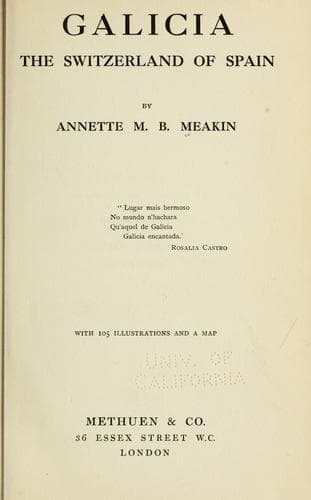
Galicia, the Switzerland of SpainMeakin, Annette M. B.
History
Galicia, the Switzerland of Spain
Meakin, Annette M. B.
Galicia (Spain : Region)
“These monuments were all sculptured in Italy,” explained the priest,
“where Carrara marble and sculpture are comparatively cheap: it is easy
to bring them here by sea from Genoa.” One of the pantheons was like a
chapel. We looked through its glass doors, protected by a strong iron
gateway, and saw an altar with four high candles, flowers, and crucifix
at the farther end; each candle had a big black ribbon bow with long
ends hanging down; in front of the altar were two _prie-dieu_ chairs,
which had the appearance of being in constant use. To our left as we had
entered we had noticed a round edifice lighted with high oval windows.
The priest told us this was the mortuary, that all unclaimed corpses
were brought here and laid on the marble slab in the centre, and that
this was the spot where inquests were held. A little below, there was a
sort of inner cemetery where--so said the priest--all the children who
died under seven years of age were buried. We read the inscriptions over
several of these little graves, and noticed that nearly all had the
words “ascended into heaven on----” and then followed the date.[186]
And we were reminded of the fact that “early death is held in Spain to
be rather a matter of congratulation than of grief.”[187]
We now returned to our carriage, and drove to the Tower of Hercules.
Between the rocks that ran into the sea and were at every moment being
covered by its white foam and the great square tower, were stretches of
green cornfields, which, to our surprise, were covered with waving oats
ready for cutting, and actually being cut before our very eyes by
peasant women with small prehistoric crescent-shaped hand
sickles--another sight strange to English eyes in the middle of January!
But a cold wind was blowing from the sea, and we were glad that the hot
sunshine had not tempted us to leave our warm wraps at home: we now drew
them well round us, and proceeded on foot to examine the tower. To walk
round its square base, I had to take eighty good steps. The original
construction of this tower is attributed to the Phœnicians, who have
been called the first civilisers of Spain, and who also erected a Tower
of Hercules in the neighbourhood of Cadiz. The material of which this
tower is built consists of small stones about a foot square, cemented
together with pebbles in the gaps. It has three storeys, and the roof is
of the same material as the vaults. The storeys, connected with one
another by a wooden stair, are said to date from the time of
Captain-General Uceda. On the stones is the following inscription:[188]--
LVPVS CONSTRVXIT EMV
LASVS MIRACVLA MEMPHIS
GRADIBVS STRAVIT YLAM
LVSTRANS CACVMENE NAVES
.....S XDDVO
Public-domain text, read in full here on John Shaqi.
Reviews
Reviews
No reviews yet
Be the first to share your thoughts on this work.
Elsewhere in the archive
Join the Discussion
Join the discussion
Sign in to leave a comment or review.
Sign InorCreate an account