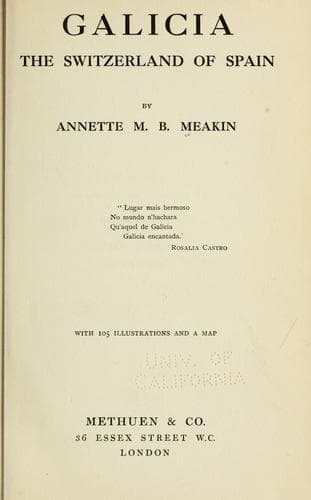
Galicia, the Switzerland of SpainMeakin, Annette M. B.
History
Galicia, the Switzerland of Spain
Meakin, Annette M. B.
Galicia (Spain : Region)
In olden days the tower was surrounded on the outside by a wide spiral
stair supported at each corner by a stone pillar. On November 17, 1684,
the English, Dutch, and Flemish consuls pointed out to the
Captain-General, the Duke of Uceda, the great convenience that would
result were he to turn the Tower of Hercules into a lighthouse. The
three consuls stated further that all the expenses could be easily
defrayed if a small contribution were levied on each vessel that entered
the harbour during the space of ten years. The outer staircase must have
ceased to exist before the year 1549, since at that date the monk
Francisco Molina of Malaga stated in his _History of Galicia_ that it
had been taken down, he did not know by whom. Molina also stated that
this tower was so famous that few authors omitted to mention it. “Some
say,” he added, “that it once had a great mirror in which could be seen
the ships at sea, no matter how far away they might be sailing,” but he
explains that all this was a fable, and that what the tower really had
was “a light, which it ought to have still, to guide the ships that
would enter the port by night. This tower,” he continues, “is close to
the town, on the seashore: it is of such great height and of such
antiquity that it is truly a marvel, and its winding stone stair, which
once formed part of the tower, was the most remarkable thing about it; a
cart drawn by two oxen could mount to the top.” This last sentence gives
one the idea that there must have been ramps, not steps. As for the
mirror mentioned above, it may perhaps have been a metal camera obscura
something after the style of that to be seen in our day in the
Observatory on Clifton Downs.
Florez looked upon the story of the mirror as a fable, and thought it
must have originated from the fact that Orosius speaks of a very lofty
lighthouse in Galicia called a _Specula_. Florez also states that the
present tower cannot be traced farther back than to the Romans;
moreover, the material of which it is built is the same as that of other
Roman structures. The historical notices of this tower differ so much
from one another that the exact truth regarding its erection seems
unobtainable, but the most trustworthy reference is thought to be the
one which indicates that it was the work of the Emperor Trajan, because
no geographer before his date makes mention of the existence of such a
colossal monument. The following inscription has been found on one of
the rocks which form its foundations:--
MARTI
AUG. SACR
G. SEVIVS
LUPUS
ARCHITECTVS
AF....SIS
LVSITANVS. EX. Vº.
Public-domain text, read in full here on John Shaqi.
Reviews
Reviews
No reviews yet
Be the first to share your thoughts on this work.
Elsewhere in the archive
Join the Discussion
Join the discussion
Sign in to leave a comment or review.
Sign InorCreate an account