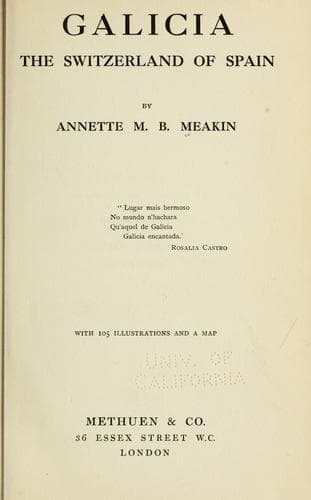
Galicia, the Switzerland of SpainMeakin, Annette M. B.
History
Galicia, the Switzerland of Spain
Meakin, Annette M. B.
Galicia (Spain : Region)
The beautiful hills and valleys of Galicia inspire her children with
such a wild and passionate love of home as I have never met with
elsewhere. Emigrants from all countries suffer more or less from
home-sickness, but it is only the emigrants of Galicia who die of it.
Yes, many and many a Gallegan peasant has died of sadness because he
could not return to his native land. This home-sickness is a real
malady, it has a special name in the Gallegan language; it is called
_morriña_.[198] It is not surprising, then, that Galicia’s sons far away
in Cuba should have collected money to raise a monument to the memory of
a poetess who expressed their woes with such idyllic sweetness, and in
the melodious dialect of their dear native province that they had
learned as children at their mother’s knee. And this fervent
appreciation of the poetess is no mere local cult; it goes wherever a
Gallegan goes, it accompanies the emigrants as they embark for other
shores, and the name of Rosalia Castro is honoured wherever Gallegans
are to be found.
Rosalia Castro was brought up at Padron, and it was there that she
breathed her last; a tablet on the house that she lived in bears the
date of her death, 15th July 1885. Her earliest work, and perhaps her
best, was a small volume of popular poems entitled _Cantares Gallegas_:
she also wrote a book entitled _As Viudas d’os vivos e as viudas d’os
mortos_ (“The Widows of the Living and the Widows of the Dead”). Rosalia
began to write poetry at the age of eleven. At the age of twenty she was
married to Señor Murguia. Her death occurred in her forty-eighth year.
She published several novels, and wrote a great deal more poetry than
was ever published, but before her death she expressed a wish that all
her unpublished writings might be burned--and her friends respected this
wish.
_Follas Novas_ is perhaps her most popular volume; it consists of a
collection of short lyrics. I tried hard to buy a copy, but it has long
been out of print, and was not to be had even in Madrid. Failde[199]
relates that a man who possessed a copy, being asked to sell it, replied
that he would not part with it for its weight in gold. The only one of
Rosalia’s books which reached a second edition is her first, _Cantares
Gallegas_, but that, too, is now out of print. Both of these volumes
were, however, lent to me during my stay in Galicia, and from them I
copied a few of the lyrics that pleased me most.
So well are the _Cantares_ known in Galicia, that every one of them has
become a part of the folklore of the province. “We hear them sung,”
writes Failde, “in the most lonely villages on the most distant heights,
and in the largest towns.” Yet Rosalia was not Galicia’s only poetess;
contemporary with her were Sofia Casanova, who is still living, Narcisa
Perez de Reoyo, “whose life was that of a flower,” Avelina Valladares,
and Filomena Dato Muruáis, whose acquaintance I had the pleasure of
making during my visit to Orense.
Public-domain text, read in full here on John Shaqi.
Reviews
Reviews
No reviews yet
Be the first to share your thoughts on this work.
Elsewhere in the archive
Join the Discussion
Join the discussion
Sign in to leave a comment or review.
Sign InorCreate an account