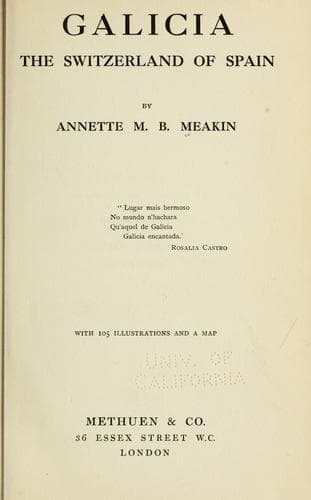
Galicia, the Switzerland of SpainMeakin, Annette M. B.
History
Galicia, the Switzerland of Spain
Meakin, Annette M. B.
Galicia (Spain : Region)
Failde speaks of Rosalia as “an Æolian harp made of Celtic oak,” and
“Galicia’s nightingale,” and he tells us in his little biography of the
poetess that she was a model daughter, wife, and mother. She came of an
old and noble Gallegan family, a family that had already produced many
poets. Rosalia was born at Santiago on 21st February 1837. She was
always “very delicate,” and the greater part of her life was a martyrdom
through ill-health. In some of her poems she complains of the damp and
cold of the long Santiago winters.
Rosalia’s poems are not in sympathy with the socialistic agrarianism
that is spreading so fast in Andalusia; she liked to think that there
was not a family in Galicia, however poor, that did not possess its own
home and its own bit of land.
“Miña cariña, meu lar,”
were words breathed from her very soul, and we English can translate
them by our own equivalent--
“Home, sweet, sweet home.”
Thierry said of the Ancient Britons that they lived upon poetry, and
their poets had but one theme, the destiny of their country, its sorrows
and its hopes. The Gallegans come of the same Celtic stock, and their
love of poetry and their passion for home are quite as intense. “A
Gallegan sticks to his native land,” says Failde, “like meat to the
bone.”
Rosalia’s poetry, though full of majestic sadness, is by no means
pessimistic; she is full of Christian resignation, but she is not devoid
of Christian hope. “Rosalia,” wrote Emilio Castelar, “by her Gallegan
lyrics has become a star of the first magnitude in the vast horizon of
Spanish art.” There is nothing more tender or more full of feeling to be
found in Spanish poetry than her lyric, “Padron, Padron.” One of the
most striking characteristics of this poetess was her insight into the
relationship between the exterior and the interior world. To her the
earthly horizon was an emblem of the horizon that spreads before the
human mind, the light of the stars spoke to her of the light of the
eyes; a shower of rain reminded her of human tears, electricity in the
clouds brought to her poetic mind the electric current of human
sympathy. Nature spoke to her, and she listened. There is no effort
about her verses; they are the outpourings of a poetic soul, candid and
pure and simple and sparkling as the limpid waters of her native
streams. “I have only had a village education,” she says naïvely in one
of her prefaces, and in another she says, “We women are like a harp with
only two strings, imagination and sentiment”;[200] and she adds that if
a woman touches science she impregnates it with her innate debility.(!!)
Rosalia writes because she cannot help writing; she is like a musical
instrument that sounds because the strings are touched.
“Aimer, prier, chanter, voilá’ toute sa vie ...”
Public-domain text, read in full here on John Shaqi.
Reviews
Reviews
No reviews yet
Be the first to share your thoughts on this work.
Elsewhere in the archive
Join the Discussion
Join the discussion
Sign in to leave a comment or review.
Sign InorCreate an account