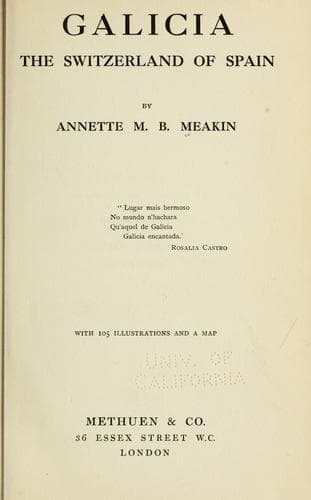
Galicia, the Switzerland of SpainMeakin, Annette M. B.
History
Galicia, the Switzerland of Spain
Meakin, Annette M. B.
Galicia (Spain : Region)
All the shops were shut, and the whole town presented an appearance of
mourning. The townspeople walked two and two in perfect silence from the
station outside the town to the entrance of the church, drawing up
before the steps of the university, where a local orator gave a short
address, upon the close of which a student recited one of Rosalia’s
poems to the listening multitude. Then the students showered a rain of
laurel wreaths upon the coffin, while the musicians played Shadello’s
“Pieta Signor,” and tears flowed on every side.
As the procession arrived at the church of Santo Domingo, an unusual
spectacle presented itself. The students of the university awaited with
lighted torches the arrival of the bier, and carried it into the church
upon their own shoulders. “I never saw anything more touching,” writes
Failde, “than the sight of so many young faces streaming with tears, and
I do not know whether those tears flowed more for their poetess or for
their country.”
“Lugar mais hermoso
No mundo n’ hachara
Qu’ aquel de Galicia
Galicia encantada.”
It has been said that only those regions which have a peculiar and
individual vitality can produce a literature of their own. The very fact
that Galicia possessed--in the early Middle Ages--both prose and poetry
composed and written in her particular dialect is a sign in itself that
she was once full of life and energy. As we have seen in a previous
chapter, the language of Galicia has justly been called the mother of
Portuguese. “Great is the excellence of the Gallegan tongue,” wrote the
Marquis of Figueroa,[202] “not only because it adapts itself so easily
to poetic expression, but also on account of its great and noble past.”
Galicia is rich in legends, which, to the ignorant peasants, are gospel
truths; she is rich in historic ruins; in every town the escutcheons on
her houses tell of noble families that flourished in her midst. Once one
of the most important and influential parts of the kingdom, she gave her
language to the court, and it was through Galicia that the poetry of
Provence passed into Castille and Portugal.[203] But after the fifteenth
century, when her autonomy had been taken from her, and when she had
sunk to the level of an abandoned and almost forgotten province, there
was no vitality left in her, and the stream of her literature was dried.
Her political decadence had brought with it literary decay. Her best
families left her to settle in Madrid and the rising towns of Spain, and
the interests of the province paled before those of the capital and the
Court. Even her poets abandoned the language of Galicia in favour of
that of Castille.[204]
Public-domain text, read in full here on John Shaqi.
Reviews
Reviews
No reviews yet
Be the first to share your thoughts on this work.
Elsewhere in the archive
Join the Discussion
Join the discussion
Sign in to leave a comment or review.
Sign InorCreate an account