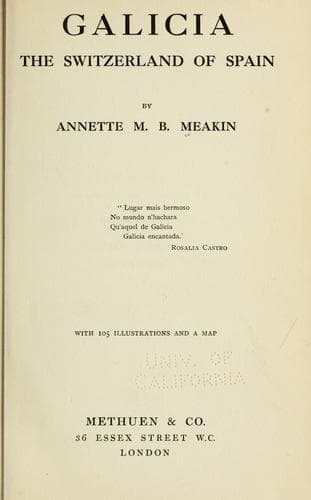
Galicia, the Switzerland of SpainMeakin, Annette M. B.
History
Galicia, the Switzerland of Spain
Meakin, Annette M. B.
Galicia (Spain : Region)
As de Voguë said of the Russian poets, “Les poetes Russes no sont et ne
seront jamais traduits,” so it is with the poetry of Galicia. Both the
Russian and the Gallegan are full of sweet and tender and untranslatable
diminutives infinitely musical and vividly expressive.[201] When we try
to interpret them into a foreign tongue their music dies and their soul
evaporates, leaving nothing behind but a dry husk of words.
Here is one of Rosalia’s shorter lyrics:
“Un-ha vez tiven un cravo
Cravande ne corazon
Y eu non m’acordo ẍa s’era aquel cravo,
D’ouro, de ferro, ou d’amor
Soyo sei que me fiẍo un mal tan fondo,
Que tanto m’atormentou
Qu’ eu dia e noite sin cesar choraba
Cal chorou Madanela n’a pasion.
--Señor, que todo o’ podedes,
Pedinele un-ha vez á Dios,
Daime valor par’ arrincar d’ un golpe
Cravo de tal condicion
E doumo Dios e arrinqueino,
Mais ... quen pensara?... Despois
Ẍ non sentin mais tormentos
Nis soupen soupen qu’ era dolor
Soupen sô, que non sei que me faltaba
En donde o cravo faltou,
E seica, seica tivan soidades
D’aquela pena.... Bon Dios!
Este barro mortal qu envolve o esprito
Que-o entendera, Señor?”
I have translated it as literally as possible for those of my readers
who may not be able to read the original--
“A nail had once been driven
Into my very heart;
But whether of gold, or iron, or love?--
I only remember its smart.
I only know the anguish
And the torment that it gave:
All day, all night, it made me weep,
Like Mary at the grave.
‘My God!’ I cried, ‘give courage
That I may tear away
That cruel nail.’ My prayer was heard,
I tore it out that day.
But oh, who will believe me?
I did not know ’twas pain;
I felt an aching, aching void,
And a longing to have it again!
What? Was I really yearning
For the anguish I had lost?
Good God! Who understands it--
Our spirit’s mortal crust!”
On 25th May 1891, the earthly remains of Rosalia Castro were transferred
to the church of Santo Domingo, “the Gallegan Pantheon.” The whole town
of Santiago took part in the ceremony, and a procession followed the
bier,--a procession in which all the societies, the university, the
colleges, the professors, the students, the employers of the telegraph,
of the banks,--in fact everybody took part. Long rows of children
bearing lighted candles preceded the hearse, which was followed by men
bearing the standards of Galicia; Cuba was also represented.
Public-domain text, read in full here on John Shaqi.
Reviews
Reviews
No reviews yet
Be the first to share your thoughts on this work.
Elsewhere in the archive
Join the Discussion
Join the discussion
Sign in to leave a comment or review.
Sign InorCreate an account