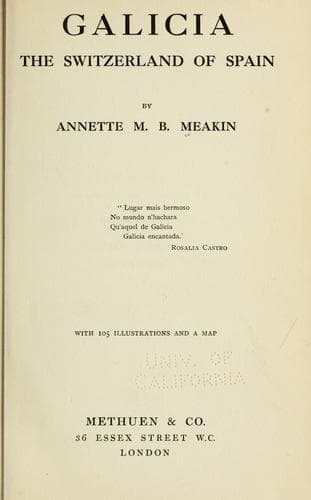
Galicia, the Switzerland of SpainMeakin, Annette M. B.
History
Galicia, the Switzerland of Spain
Meakin, Annette M. B.
Galicia (Spain : Region)
The modern university building, which was designed by José Machado, is
entirely of granite, and looks very important with its sculptured
pediment supported by four Ionic columns, and its triple flight of
steps. It has three storeys and a handsome marble staircase, and a
central patio in which there stands a great two-faced clock, on a
pedestal so tall that it can only be reached by a long ladder, and is
therefore seldom wound up and not to be trusted. On the ground floor
there are six spacious and well-lighted lecture halls, but the finest
thing in the University is its splendid Library of more than seventy
thousand printed volumes and some six hundred manuscripts, many of them
“the sweepings of convents.” The books are arranged in cases, with wire
in place of glass, round a spacious reading-room that will accommodate a
hundred readers. Over the entrance is written--
“Deum domus alma silescit.”
In glass cases, placed in the centre of the reading-room, are some
highly-prized literary treasures; among which I saw a beautifully
preserved Commentary on Dante’s _Inferno_, by Landino, published at
Florence, and bearing the date 1485; also an illustrated volume
published by Schectel and Hartmann at Nuremberg in 1493, and other fine
specimens of early printing. I also saw and handled an illuminated
_Diurno_ or Book of Daily Prayer that had belonged to Ferdinand I., and
bore the date 1055; in it I saw a miniature in which the copyist is
presenting the book to the king and queen; all the capitals are
illuminated, and all different. There is also some eleventh century
musical notation in it, the notes are represented by dots
(pentagrammic) over the words, and without any lines. The book itself
tells us that it was written by Pedro and painted by Fructuoso. In the
opinion of M. Macìus Férotin,[209] this _Diurno_ is the most precious
document in the university of Compostela; its chronology, written in
gold letters, fixes the chronology of the last three kings of Leon.
Férotin thinks that the lines in honour of King Bermudo III. were
dictated by the queen herself. Bermudo died in battle. Sanchez believed
this treasure to have been among the “sweepings” of the monastery of
_San Martin Pinario_. A beautifully bound volume of the writings of St.
Thomas Aquinas, with an exquisitely stamped leather cover, was also
shown to me. In another case I found what is said to be one of the
oldest, if not the very oldest, specimens of handwriting in Spain--a bit
of brown parchment about eight inches long and four deep, representing a
bill of sale of a little village called Nogueira, near Lalin. The date
on it is Era 826 (A.D. 788), and the language used is Latin: it is from
the great monastery of Carboeiro, in the province of Pontevedra. Another
document was shown to me bearing the date 1504, it was the last will and
testament of Don Alfonso de Fonseca, the founder of the university.
Another parchment bore the seal of Alfonso VII.; this was a charter
Public-domain text, read in full here on John Shaqi.
Reviews
Reviews
No reviews yet
Be the first to share your thoughts on this work.
Elsewhere in the archive
Join the Discussion
Join the discussion
Sign in to leave a comment or review.
Sign InorCreate an account