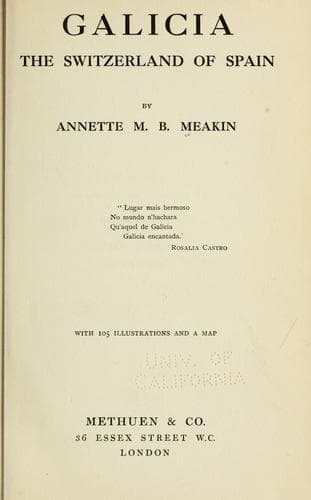
Galicia, the Switzerland of SpainMeakin, Annette M. B.
History
Galicia, the Switzerland of Spain
Meakin, Annette M. B.
Galicia (Spain : Region)
conferring certain privileges on a monastery. There were also two
manuscript Bibles of the fifteenth century, written and illuminated by
monks of the neighbouring convents; the text was in Latin, the pages
were like silk, and the colours wonderfully preserved.
The librarian, Señor B----, took me into his private room, adjoining the
Library, to see the flag that was carried by the Santiago students, who,
to the number of twelve thousand, formed themselves together into a
volunteer battalion, and fell defending Galicia against the troops of
Napoleon in 1808. The student chosen by his companions as their leader,
Don José Ramon Rodil, became in later years both Minister of War and
President of the Ministerial Council. In honour of his services, his
country raised him to the rank of a marquis. Aguiar, writing in 1836,
waxed eloquent over the heroes of Santiago university. “The University
of Santiago,” he wrote, “has given us three Ministers for our
Government, and four Generals for our Army, all from its battalion of
student cadets who immortalised themselves in the defence of our
country.” On another wall was the portrait of Don Diego de Muros, and
that of Filippo de Castro, a famous Gallegan sculptor of whom we shall
have occasion to speak again later on. There was also a portrait of
Emmanuel Bonaventuræ Figueroa, who founded the Library, and left estates
the revenues of which were to be employed in starting all his
descendants in life: if men, they are entitled to a university education
or a share in some business; if women, to a dowry! What a fine old
fellow he must have been. I hear that his estates have increased in
value, and the librarian told me that quite poor people keep
unexpectedly turning up and claiming relationship--even a nephew seven
times removed can claim his share. Another portrait was that of
Archbishop Fonseca, whose Will I had seen in the glass case.
The Reading Room is divided into two by a passage, and one half of it is
reserved for distinguished readers who might not care to sit among the
general public; the other is open to the students and to the public
during the hours of daylight. The books round the walls are all arranged
according to their size, in order to economise space; each volume is
numbered, and by means of a corresponding card it may be easily found by
the attendant. The method is similar to that adopted by our Geographical
Society, boxes of cards taking the place of catalogue volumes. A subject
catalogue is in course of preparation, and Señor B---- is determined
that no pains shall be spared to make the Library one of the most
perfect of its kind. Underneath the Reading Room is another room of the
same size, also lined with books; its ceiling and bookcases are
decorated with the white-and-gold Louis XVI. decorations that once
adorned the monastic library of San Martin Pinario, and many of its most
precious volumes have come from the same place; others were bequeathed
by private collectors.
Public-domain text, read in full here on John Shaqi.
Reviews
Reviews
No reviews yet
Be the first to share your thoughts on this work.
Elsewhere in the archive
Join the Discussion
Join the discussion
Sign in to leave a comment or review.
Sign InorCreate an account