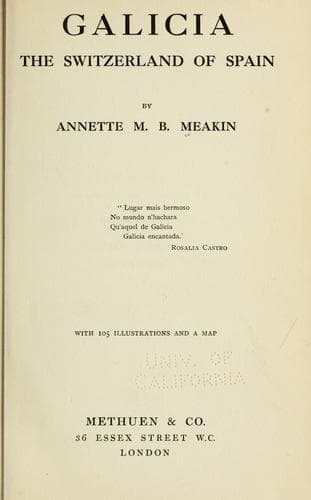
Galicia, the Switzerland of SpainMeakin, Annette M. B.
History
Galicia, the Switzerland of Spain
Meakin, Annette M. B.
Galicia (Spain : Region)
My windows looked out upon the high and sombre wall which enclosed the
women’s convent of San Payo. Curious to see beyond that wall, I ascended
into the attics and looked down upon it from the highest window in the
house, but even then I could see nothing but the garden wall, a foot and
a half in breadth. San Payo was originally a monastery founded by King
Castro on the occasion of his pilgrimage to the tomb of St. James in
813, and dedicated to St. Peter. As it faced the altar of the cathedral
it received the name of _San Pedro de Autealtares_. Its first inmates
were the holy Abbot Ildefrede and his monks, to whom had been entrusted
the care of the Apostle’s sepulchre. St. Pedro de Mozonzo was its Abbot
between 974 and 988, and for several centuries after that its abbots
and monks were honoured and respected all over Galicia. The present
building dates from the last years of the seventeenth century; its
church was consecrated in the year 1707. Sanchez devotes pages to a
description of the interior of this edifice, and of the marble _ara_
supposed to have stood upon the original sepulchre of St. James, but the
convent itself, which now encloses women, interested me far more. From
the attic window I had noted its superfluity of chimneys, and I
afterwards learned that when the building became a nunnery it was
inhabited by nuns from rich families, and that each had her own servant
and her own kitchen, until the archbishop, looking into the matter,
decided that one kitchen ought to be enough for them all, and that the
nuns ought to wait upon themselves. I was allowed to enter the great
door, and ascend the broad flight of steps to the wooden window where
visitors are allowed on certain days to speak with, but not to see, the
nuns, and on the landing I met the priest whose duty it was to minister
to their spiritual wants. After a little conversation, I asked him how
the nuns who had grown old in the convent managed without servants. He
smiled at my question, and replied that the younger nuns waited on the
older ones and did the housework for them. “But,” I persisted, “they
must all grow old in time?” To which he answered that new ones were
continually entering the convent and taking the place of the old ones.
Only three men ever enter those doors, the priest, the sacristan of the
conventual church, and the carpenter who nails the dead nuns into their
coffins and carries them out. There is a legend among the townspeople to
the effect that, a long time ago, one of the more youthful of the nuns,
getting heartily tired of her life of seclusion within those gloomy
walls, let herself down, by a rope made of twisted sheets, from one of
the windows into the Quintana, or what is now the _Plaza de los
Literarios_, intending to escape with a lover who had won her heart
before she had taken the veil; but she inadvertently hung herself, and
remained suspended till her corpse was discovered the following day. I
Public-domain text, read in full here on John Shaqi.
Reviews
Reviews
No reviews yet
Be the first to share your thoughts on this work.
Elsewhere in the archive
Join the Discussion
Join the discussion
Sign in to leave a comment or review.
Sign InorCreate an account