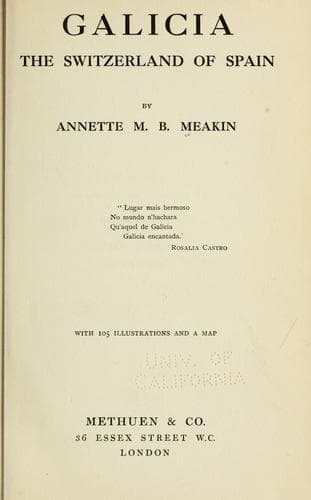
Galicia, the Switzerland of SpainMeakin, Annette M. B.
History
Galicia, the Switzerland of Spain
Meakin, Annette M. B.
Galicia (Spain : Region)
often thought of that story when I looked up at those high, prison-like
windows, and also of the report that there must be rats in the disused
kitchens “as large as men.” At six o’clock every evening I used to hear
the bells of St. Payo (or Pelayo) summoning the nuns to Mass, and so
close they sounded it seemed almost as if they were pealing for me as
well.
Santiago is rich in fortress-like convents for women. On the road to
Coruña, in a street of the same name, is situated the convent of Santa
Clara, founded in 1260 by Queen Violante, the wife of Alfonso el Sabio
(the royal _trovador_), but its present construction only dates from the
latter years of the sixteenth century, and the façade of its church is
the work of the eighteenth century, and extremely ugly. In this church
there is an elegant Gothic pulpit, which attracts the attention of
visitors, and the tomb of the Abbess Isabel of Granada, who is reputed
to have been a granddaughter of the Moorish warrior Boabdil, the last
Mohammedan king of Granada. There is another theory to the effect that
she was a granddaughter of Abul Hasan Ali, whose son Naser (her father)
entered the Catholic Church, and received the baptismal name of Juan de
Granada.
Opposite the convent of Santa Clara is the convent of (barefooted)
Carmelite Nuns, established in the eighteenth century; it has a large
church called _La Virgen del Carmen_. Close by is the _Hospital de San
Roque_, established in 1577 for the treatment of venereal diseases; it
has attached to it a modern penitentiary. The hospital was rebuilt in
1818 with funds bequeathed for the purpose by a wealthy merchant of
Villagarcia. Patients come to this hospital from all parts of the
province.
Santiago possesses a very small Archæological Museum in the _Sociedad
Economica_, or School of Art, which is a modern building in the street
of San Clements, facing the Alameda. Here are stored some old statues
thought to have once decorated the original façades of the cathedral,
one of which represents King David, and is brightly coloured. Here also
is preserved the great statue of Minerva, which once stood above the
columns of the university façade.
Public-domain text, read in full here on John Shaqi.
Reviews
Reviews
No reviews yet
Be the first to share your thoughts on this work.
Elsewhere in the archive
Join the Discussion
Join the discussion
Sign in to leave a comment or review.
Sign InorCreate an account