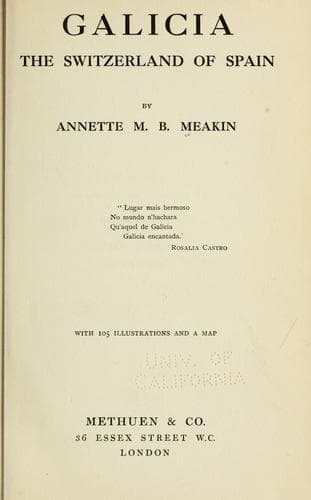
Galicia, the Switzerland of SpainMeakin, Annette M. B.
History
Galicia, the Switzerland of Spain
Meakin, Annette M. B.
Galicia (Spain : Region)
Remembering the valuable and interesting private museums I had
discovered in some of the remotest of the Russian towns, I inquired if
there were no private collections in Santiago. “Yes, we have one,” was
the reply, “it is in the house of Señor Ricardo Blanco Ciceron”; and
through the kindness of Señor Cabeza Leon I soon received an invitation
from Señor Ciceron to inspect the treasures which he had gathered
together during some forty years. Señor Ciceron is a wealthy Santiago
merchant, his comfortable house is filled with antique furniture and
other _objêts d’art_, but besides these he has a couple of rooms filled
with curios of every description and of every period of Galicia’s
history. Here I saw some fine specimens of Roman mosaic, Roman pottery,
and Roman metal work. I was struck with a beautifully preserved glass
vase, which had been discovered in a brick-tomb three feet beneath the
surface of the ground, by railway navvies, near Astorga. But the real
value of this museum lies in the collections of ancient coins, and the
collection of _torques_. Among the coins I saw a great many Phœnician,
and a still larger number of Visigothic coins (very small, and as thin
as wafers). Numismatologists tell us it is an ascertained fact that the
Carthaginians did not begin to mint for themselves until three or four
years later than their Greek neighbours.[212] Dr. Macdonald remarks that
among the ancients themselves there was a difference of opinion as to
where the first coins were struck. Herodotus thought that the Lydians
were the first people to strike and use gold and silver coins. There
seems to be no proof that they were in circulation earlier than 700
B.C.[213] Before the introduction of a metallic standard the universal
unit of value was the ox, and it is the opinion of some students that
when the primitive system of currency was superseded by a metallic one,
a picture of the article that had formerly served as money was very
naturally impressed upon the coins. There have been found in Galicia a
number of coins with an ox or other animal represented.
Among the Celtiberic coins I noticed one on which was depicted a man on
a galloping horse; on its reverse was the head of a man wearing a
helmet. There were also a goodly number of Roman coins from the time of
Augustus to that of Nero. All these had been coined at Rome, but we have
already seen that several of the Roman colonies in Galicia were
permitted to strike their own money until about the middle of the first
century A.D., when the privilege was withdrawn both from Gaul and Spain.
It seems very probable that long before coins were current in Galicia
the natives used their jewellery as money. Señor Ciceron is the happy
possessor of the finest collection of golden torques in existence, and
every one of these was dug up in Galicia. Their great weight, and the
purity of their metal, indicate that they were used for more purposes
than that of ornament alone.
Public-domain text, read in full here on John Shaqi.
Reviews
Reviews
No reviews yet
Be the first to share your thoughts on this work.
Elsewhere in the archive
Join the Discussion
Join the discussion
Sign in to leave a comment or review.
Sign InorCreate an account