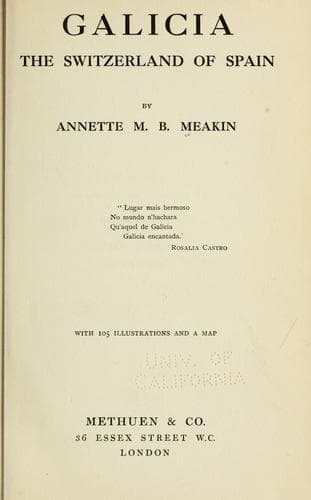
Galicia, the Switzerland of SpainMeakin, Annette M. B.
History
Galicia, the Switzerland of Spain
Meakin, Annette M. B.
Galicia (Spain : Region)
“That no person shall keep sheep or goats in the city. Persons found
guilty shall be exposed to the vengeance of the public in the _picota_
or _pelouryno_ of the city.”[216]
The churches of villages and small towns are carefully surrounded by
walls or fences, enclosing sometimes a churchyard and sometimes merely a
small plot of grass; and, in order that the pigs of the neighbourhood
may not enter that enclosed space by the gate, a trench is kept open in
front of the gate, a kind of diminutive moat about five feet in depth.
On first noticing this arrangement I put it down to quite another cause,
and thought that the “drains were up,” but after a time I began to
consider the phenomenon more closely, as it seemed incredible that
“drains” could explain the presence of so many open trenches. “It is a
custom peculiar to Galicia,” explained a lady resident, “because of the
pigs.” A pig would never jump a trench.
My readers will not be surprised to learn that bacon is an important
staple of food in Galicia. The national broth, _Caldo Gallego_, as
known to the well-to-do, could hardly be made without it, neither could
the _olla podrida_.
“No hay olla sin tocino
Ni sermon sin Augustino.”[217]
“In Spain,” says Ford, “pigs are more numerous even than asses, since
they pervade the province.” In parts of Galicia, as in the adjoining
province of Extremadura, pigs are fattened upon mast and acorns, which
are larger than those of English oaks, but in many districts they live
upon chestnuts, which give a very fine flavour to the bacon. “The
acorns,” says Ford, “formed the original diet of the aboriginal Iberian,
as well as of his pigs; when dry, the acorns were ground, say the
classical authors, into bread, and when fresh, they were served up as
the second course. Ladies of high rank constantly ate acorns at the
opera and elsewhere; they were the presents sent by Sancho Panza’s wife
to the Duchess, and formed the text on which Don Quixote preached so
eloquently to the goat-herds, on the joys and innocence of the golden
age and pastoral happiness.”
Poultry and pigs grow up together in the villages. Eggs were sold at the
rate of fivepence a dozen in Santiago a few years ago, but in the last
decade their price and that of chickens has doubled. The villagers send
all their chickens, and everything else they have to sell, to Santiago
for the festival of St. James in July, when the town overflows with
visitors; and as the supply is greater than the demand, living there
becomes very cheap.
Public-domain text, read in full here on John Shaqi.
Reviews
Reviews
No reviews yet
Be the first to share your thoughts on this work.
Elsewhere in the archive
Join the Discussion
Join the discussion
Sign in to leave a comment or review.
Sign InorCreate an account