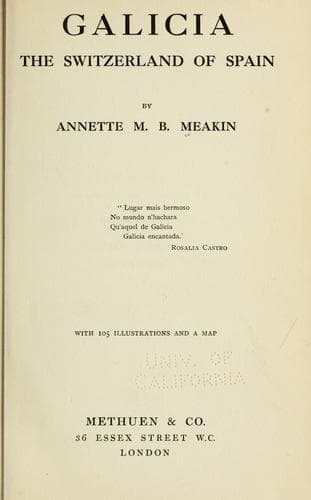
Galicia, the Switzerland of SpainMeakin, Annette M. B.
History
Galicia, the Switzerland of Spain
Meakin, Annette M. B.
Galicia (Spain : Region)
The gentle-eyed, long-horned oxen, which take the place of cart-horses,
are another feature both of town and country life in Galicia. In
northern Italy, in the month of November, I have often counted as many
as fourteen and even fifteen pairs of oxen in front of one plough; that
is a sight not met with in Galicia, where I have never seen two pairs of
oxen pulling the same plough; but in Italy they have modern ploughs,
whereas here the plough of Virgil’s day is still in use. It is the
identical plough that we see sculptured on Etruscan tombs, and on the
Celtiberic coins. The ancients used them also as weapons: Pausanius
fought with a plough at Marathon. Hesiod mentions in his _Works and
Days_ the ἀροτρον αὐτογυον, which was a stout piece bent like a
hook, with beams and share beams all in one piece. When driving along
the country roads of Galicia, we used to meet many a ploughman wending
homeward his weary way and carrying his plough upon his shoulder, while
his oxen walked on either side; and I have often seen a couple of
stalwart women engaged in tilling a field, one holding the end of the
long handle of the plough, and the other in front guiding the oxen. Why
has the modern plough not been long since introduced into this corner of
Spain?[218] Are the Gallegan peasants as inimical to improvements in the
plough as our Lancashire weavers were to the spinning jenny? By no
means: the answer is to be found in their ignorance and poverty.
The carts used by the peasants are almost as archaic as the ploughs;
their shape is that of a small boat, and their walnut wheels make a
strange screaming sound as they turn on their walnut axles, which can be
heard at a considerable distance. There is a special word to denote this
sound in the Gallegan language (_v. chirriar_; _n. chirrio_). I examined
the axles of several, and found them twice the thickness of a man’s
wrist and as smooth as satin. This “singing” of the cartwheels is not
allowed in the towns, so the peasants soap the axles when they come into
the streets; but the louder their carts sing in the fields and on the
country roads the better pleased are they, for they believe that the
oxen like the sound and will not work well without it. They also find it
convenient in narrow lanes where there is not room for two carts to pass
each other, because it warns them in good time that they are approaching
each other, and that one must halt or turn back. They say, too, that in
olden days, when the mountains abounded in wolves and bears, the singing
cartwheels frightened and kept them from attacking the oxen and their
drivers. Not only the peasants, but everybody likes to hear the
cartwheels in the quiet summer evenings; it is like the sound of the
scythe in England, and its associations are much the same. Rosalia
Castro speaks of it as one of the things she missed when she went to
live in Castille:
Public-domain text, read in full here on John Shaqi.
Reviews
Reviews
No reviews yet
Be the first to share your thoughts on this work.
Elsewhere in the archive
Join the Discussion
Join the discussion
Sign in to leave a comment or review.
Sign InorCreate an account