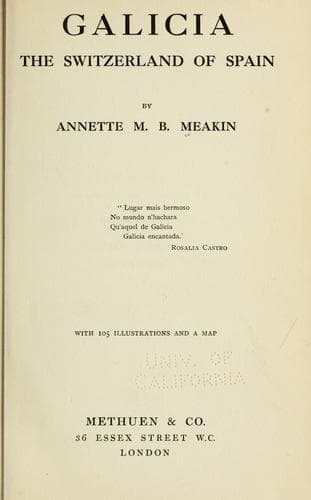
Galicia, the Switzerland of SpainMeakin, Annette M. B.
History
Galicia, the Switzerland of Spain
Meakin, Annette M. B.
Galicia (Spain : Region)
Rising from the slope of the mountain on the opposite side of the river
is a hillock, or ridge, on which stands a little chapel to mark the spot
where St. James is supposed to have dwelt during his sojourn in Iria;
below the altar is a spring of delicious pure water: Morales remarked he
had not tasted better water in all Galicia; its flow never ceases summer
or winter. The townsfolk informed me that St. James preached to the
people of Iria from this spot. Sanchez relates that in 1484 the
traveller Nicolas Popiélovo came here to see the spring; and he gives
his readers the traveller’s own words about his visit. A little higher
up the mountain, which is called _Monte San Gregorio_, is the actual
boulder upon which St. James stood when he preached. There is an opening
here between two pieces of rock through which a thin person can manage
to pass, and the Portuguese, who come here in great numbers, believe
that good fortune will befall those who can get through, consequently it
sometimes happens that fat persons also try to get through, but get
stuck in the middle and find it difficult to extricate themselves. There
are many legends connected with this rock, one of which is that it
opened on several occasions to receive and shelter St. James when he was
chased by the pagans. Another rock a little farther on is known as the
Altar of St. James, and he is there supposed to have offered up
bloodless sacrifices; and yet another rock is shown as St. James’s
couch. The view of Padron from here is very beautiful among its fields
and gardens, and with its two rivers, the Sar and the Ulla.[231] The
highest building in the town is an old Carmelite nunnery, now inhabited
by Dominican friars.
To the south-east of Padron, at a distance of about a mile, is situated
the _Convento de San Antonio de Herbon_, a Franciscan monastery founded
in the end of the fourteenth century by Gonzolo Mariño, a relative of
the first Count of Altamira. Among its monks may be reckoned the famous
_trovador_ poet, _Rodriquez de Padron_, who retired thither in his old
age and adopted the conventual garb. When the monks were all expelled,
this monastery became for a time an ecclesiastical seminary. In the
church there is a beautifully carved wood statue of St. Francis of
Assisi, which some think to be the work of Adolfo Cano; there is
wonderful character in the face, and for that alone its celebrity would
be deserved.
Opposite the monastery and on the other side of the river are the
remains of an ancient fortress, whose walls are two yards and a half
wide. Sanchez calls it Castro Valute, and states that an _ara_ was found
there in which there was a cavity to receive the blood of victims
sacrificed.[232]
Public-domain text, read in full here on John Shaqi.
Reviews
Reviews
No reviews yet
Be the first to share your thoughts on this work.
Elsewhere in the archive
Join the Discussion
Join the discussion
Sign in to leave a comment or review.
Sign InorCreate an account