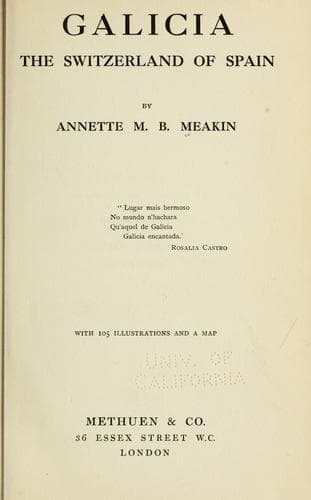
Galicia, the Switzerland of SpainMeakin, Annette M. B.
History
Galicia, the Switzerland of Spain
Meakin, Annette M. B.
Galicia (Spain : Region)
“Ah, of course, and so they should. Poor things! Poor things! How
dreadful to turn them out like that!”
Entering the tiny church, I found that its granite walls were painted,
and, worse still, the sculpture of its granite capitals was decked out
in glaring colours. To paint stone in this way was a fashion peculiar to
the eighteenth century. At one time the Cathedral of Santiago was thus
painted over. It is only since 1840 that the colour has been removed; we
still see red and white stripes where the blocks of granite are joined.
As I was returning to the carriage, some children presented us with some
branches covered with cherry-blossom which they had picked from their
garden in their wish to please us; they were indignant when we offered
them silver in return.
Returning to Padron, we lunched at the little inn, and found a salad
made of red peppers particularly cool and refreshing after rather a hot
drive. Then we went to see the pretty spot on the river-bank where the
market is held, and the house where Rosalia Castro died, with its tablet
to her memory. Padron seemed to me an ideal place for a poet to live and
die in; its beauties are so varied, its outlines so delicate, and the
blue haze upon its surrounding hills so romantic. One great charm about
this miniature beauty is, that at every few steps, whether you walk or
drive, the scene changes; nothing is so big as to appear unchanged when
the observer has moved on. In the great valleys of Switzerland and the
Tyrol you may walk long distances without getting any perceptible change
in the picture, but in Galicia, and especially in places like Padron,
the scenery may almost be termed kaleidoscopic--only that the employment
of such a word suggests suddenness, and there is nothing sudden here--it
is a gradual melting process, where no beauty is so large and coarse as
to obstruct another or become monotonous. Macìas, the Poet of True Love,
was born near Padron, and Juan Rodriquez was born at Herbon: we have
already seen that it was in the monastery there that this _trovador_
chose to end his days. Rodriquez wrote, _El Siervo Libre de Amor_, “The
Free Slave of Love.” He flourished in the first quarter of the fifteenth
century. He is sometimes called _Rodriquez de la Camara_.[233]
Public-domain text, read in full here on John Shaqi.
Reviews
Reviews
No reviews yet
Be the first to share your thoughts on this work.
Elsewhere in the archive
Join the Discussion
Join the discussion
Sign in to leave a comment or review.
Sign InorCreate an account