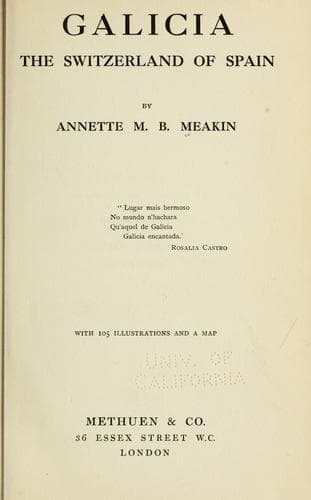
Galicia, the Switzerland of SpainMeakin, Annette M. B.
History
Galicia, the Switzerland of Spain
Meakin, Annette M. B.
Galicia (Spain : Region)
The next day I called at the convent of the Trinitarian nuns to take a
message to one of the inmates from her married sister in Santiago. The
outer walls of this convent were a yard wide; opening into the dark
porch was a large window with a revolving wooden shutter, concave in
shape, like half a barrel. Through this opaque window I had to announce
my name and the object of my visit to an invisible nun who had answered
the bell by calling to me from the other side of the barrel. She began
every sentence she uttered with “Ave Maria,” and then went to ask the
Mother Superior if I might speak with the nun for whom my message was
intended. When she came back she tapped the wood several times to let me
know she was there, and then informed me with more “Ave Marias” that if
I would came again after Easter I might perhaps speak with the nun, but
not before. It ended in my having to return to Santiago without giving
my message. I discovered afterwards that though these nuns appeared to
be terribly shut in, they have, stretching far behind their convent, a
beautiful garden, which they tended themselves with great industry. They
also have a school for girls, where a speciality is made of fine
needlework and embroidery.
The largest and the most important church in Noya is that of San Martin,
which dates from the year 1434, and was built by Archbishop Lopez de
Mendoza. This edifice has been singled out by Señor Lamperez as a fine
and typical example of Galicia’s popular style of architecture, a style
which, dominated by laws dictated by local common sense, abandoned the
exotic styles which had preceded it, and boldly adopted both the
traditions and the materials that were to be found on the spot. This
popular architecture was divided into two branches, under the first of
which may be classed the parish churches, and under the second those
attached to the monasteries--the conventual churches;[239] these are two
distinct types, but they have one characteristic in common, namely, the
wooden roof, the kind best suited to the conditions
[Illustration: THE BED OF SAN MAMED, NOYA]
[Illustration: CLOISTER OF SAN JUSTO DE TOJOSUTOS, NOYA]
of the country. A wide nave covered with a roof of wood offered no
difficulties as to equilibrium; we find it in some of the ancient
architecture of Syria; and in the Middle Ages it was introduced, as
Lamperez reminds us, both in the churches of Languedoc and in those of
Catalonia and Valencia. Galicia was very slow to adopt the Gothic style;
she clung to the older ones, the Byzantine and the Romanesque, long
after these had been completely abandoned in other parts of Spain, and
the consequence is that she does not possess a single edifice that may
be termed a good example of the Gothic style. There is no province,
however, in which the travellers will find a more favourable opportunity
of studying the period of Transition.
Public-domain text, read in full here on John Shaqi.
Reviews
Reviews
No reviews yet
Be the first to share your thoughts on this work.
Elsewhere in the archive
Join the Discussion
Join the discussion
Sign in to leave a comment or review.
Sign InorCreate an account