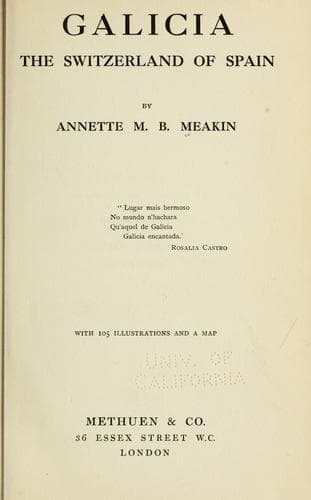
Galicia, the Switzerland of SpainMeakin, Annette M. B.
History
Galicia, the Switzerland of Spain
Meakin, Annette M. B.
Galicia (Spain : Region)
As we were descending the hill to rejoin our conveyance, we entered a
cottage and had a chat with its owners. On my expressing a wish to see
the rooms, the woman took me by the hand and led me through a passage
and up stairs so dark that we had to strike a light to see the steps. In
a room on the upper floor there was a bed covered with a neat
counterpane. “This room belongs to my nephew who has gone to America,”
she said, with a touch of sadness in her voice. “We have only had one
letter from him since he arrived there, and that came a month ago.”[246]
The cottage, built of granite slabs, had hardly any windows; most of the
rooms were low and dark, and we were in danger of knocking our heads
against the rafters. The old man looked very hale and hearty; quite fit
for another ten years of active life.
“How old do you think me?” he asked, and then he added: “I am
eighty-six; I was born in 1821. In my younger days I was a grenadier in
the Engineers; I have served in almost every part of Spain.”
When we emerged to the sunlight I looked at him more closely. He was a
tall, well built fellow with a fine military bearing, and had features
that would have done credit to a general.
A couple of miles farther on we came to a little church (upon our
right), which dated from the twelfth century, and had a Romanesque
entrance not unlike that of _Santa Maria de Sar_, a semicircular arch
resting upon columns with sculptured capitals--only much rougher in its
workmanship; the apse was eighteenth-century work, square in form and
much higher than the nave. The apses were lower than the nave until the
fifteenth century, and often circular in form. This church was
constructed entirely of granite; the statues which once stood in its
niches are now placed in the wall of the apse; the churchyard was full
of horizontal tombstones. On festal occasions a procession of peasants
passes over them with as little concern as if they were paving stones.
The Gallegans have none of our superstitious horror of graves and
coffins, but like to have the remains of their departed always near
them.
Public-domain text, read in full here on John Shaqi.
Reviews
Reviews
No reviews yet
Be the first to share your thoughts on this work.
Elsewhere in the archive
Join the Discussion
Join the discussion
Sign in to leave a comment or review.
Sign InorCreate an account