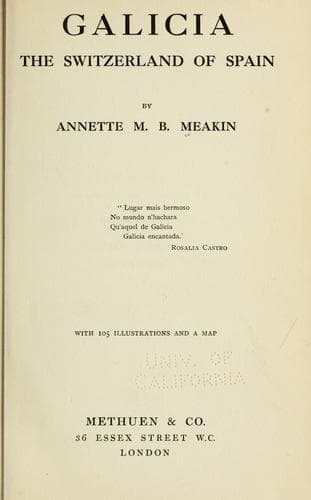
Galicia, the Switzerland of SpainMeakin, Annette M. B.
History
Galicia, the Switzerland of Spain
Meakin, Annette M. B.
Galicia (Spain : Region)
The line from Tuy to Orense runs through scenery more beautiful than
that of the Austrian Tyrol. For a long time the winding Miño is visible
close beneath the train windows, as it makes its way through the verdant
valley, banked by mossy boulders and clumps of pine or chestnut trees,
and now and again rushing through narrow ravines. The first station we
passed was that of Salvatierra, near which towered a mediæval fortress
almost hidden by ivy, while, dotted about, were some little houses
painted red. Terraces of vines now covered the sloping hills; every now
and again we were in the thick of a pine wood. The station in the pine
wood was Nerves: between it and Arbo the Miño’s bed grew very narrow
and stony, and the waters foamed as they forced their way between the
boulders; then they whirled round in an eddy, and the next minute we
were looking at a sparkling waterfall, below which a peasant sat fishing
with a very long line. At Pousa, the next station, we compared the
architecture of the houses on the Portuguese side of the water with that
of the Spanish houses on the opposite bank: the Portuguese houses were
larger and more commodious in appearance. Steep mountains walled us in
as we neared the station of Freira, and our train described a curve or
loop worthy of the Canadian Rockies. After the next station, Filgueira,
the river burst from its granite ravine and fled round the circular base
of a conical mountain.
We had now reached Ribadavia, and the country on all sides was covered
with vine terraces. Ribadavia, hardly more than a large village in the
district of Ribadavia, in the province of Orense, was once an important
town. Garcia, king of Galicia, the son of Ferdinand the Great, had his
Court at Ribadavia, and his palace stood on the spot now occupied by a
Dominican convent. There are two churches at Ribadavia that are well
worth a visit--the conventual Church of Santo Domingo, and the Church of
Santiago. The former is a good specimen of Gallegan architecture, with
its wooden roof and its whitewashed granite walls and arches; the latter
has an interesting Romanesque window.
Orense, it will be remembered, is one of the four provinces into which
modern Galicia is divided. It is bounded on the north by the provinces
of Pontevedra and Lugo, on the south by Portugal, on the east by Zamora
and Leon, and on the west by Pontevedra and Portugal. Its most important
rivers are the Miño, the Sil, the Limia, and the Bibey. The chief town,
Orense, is situated in an extensive and luxuriant valley which lies in
the midst of mountains, many of them having summits of bare rock devoid
of all vegetation. Orense is a clean, bright little town, with more
movement in its streets than is usual in Gallegan towns; it is in closer
connection with Madrid than the others, and has not that mediæval look
so characteristic of the province.
Public-domain text, read in full here on John Shaqi.
Reviews
Reviews
No reviews yet
Be the first to share your thoughts on this work.
Elsewhere in the archive
Join the Discussion
Join the discussion
Sign in to leave a comment or review.
Sign InorCreate an account