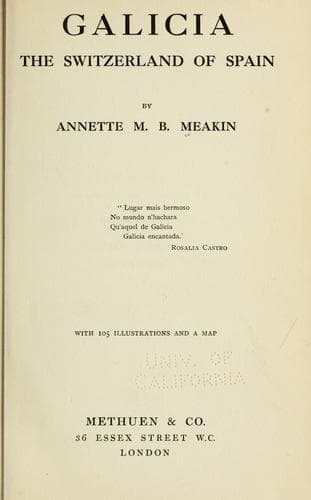
Galicia, the Switzerland of SpainMeakin, Annette M. B.
History
Galicia, the Switzerland of Spain
Meakin, Annette M. B.
Galicia (Spain : Region)
The rise of Gothic architecture began in the early part of the eleventh
century, which forms one of the most important epochs in the annals of
the Roman Catholic Church; it began at a time when civilisation, fleeing
from the brutalities of feudalism, had taken refuge in the
cloister.[117] It was then that the sap of a new life began to rise in
the old tree,--a life thirsting for liberty, and open to all development
and progress. It was between the beginning of the last decade of the
thirteenth century and the end of the first part of the fourteenth that
the sap rose highest. The work of civilisation passed from the hands of
the monks to the hands of the newly formed middle classes. Before that
time all the architects and even stone-masons were monks. Montalembert
tells us how our own English monk of the seventh century, St. Wilfrid,
brought stone-masons (_coementarii_) from Rome to build his beautiful
conventual church at Ripon.
The king, formerly only a figurehead, now recovered his regal
power;[118] the bishop, formerly subject to the abbot, now stood above
that dignitary; the city became a municipal community, struggled for its
rights and privileges, erected its own municipal buildings; the
artisans, no longer feudal serfs, formed themselves into guilds,
corporations and fraternities so exclusive, that none might be initiated
into the secrets of their trade without undergoing long years of
apprenticeship.[119]
With all these changes, architecture kept pace. “It felt in its soul a
burning life which urged it to the most daring conceptions.”[120] Gothic
architecture represents not a revolution in art, but an evolution. The
sap rose in the old trunk, and the buds burst forth from the old
branches. It is a mistake to think that Gothic architecture was
introduced into Europe from the East by the Crusaders; these soldiers
did not, as Viollet le Duc has remarked, bring back art in their
knapsacks--they had other things to think of.[121] The constructors of
Romanesque art had struggled with a double problem--how to support wide
vaultings, and how to let light in upon dark naves. Merchants of the
ninth century, pilgrims of the tenth and eleventh, Crusaders of the
twelfth, all had their influence. Larger churches with wider vaultings
became urgently needed. The new cathedrals were to play a civil as well
as religious part--quite different from that which had been played by
the conventual churches. These are some of the elements which
contributed to the development of Gothic architecture.
Public-domain text, read in full here on John Shaqi.
Reviews
Reviews
No reviews yet
Be the first to share your thoughts on this work.
Elsewhere in the archive
Join the Discussion
Join the discussion
Sign in to leave a comment or review.
Sign InorCreate an account