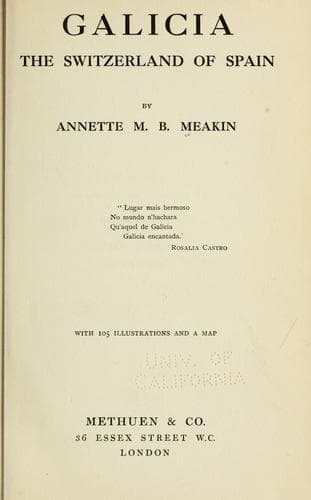
Galicia, the Switzerland of SpainMeakin, Annette M. B.
History
Galicia, the Switzerland of Spain
Meakin, Annette M. B.
Galicia (Spain : Region)
Just as the cathedrals were the expansions of the conventual churches,
the universities were expansions of the monastic schools; and, as
Preissig has observed, this transformation was due in the main to the
great reputation for learning enjoyed by the schoolmen, “who attracted
such multitudes of students that it was found necessary to recognise the
schools on a broader basis.”[122] Our own oldest university, that of
Oxford, owes its foundation to a mandate from the Holy See. The first
university to be founded in Europe was that of Paris. The second was
that of Bologna.
Though Spain possesses some of the finest specimens of Gothic
architecture in the world, she has never made that style her own. Her
grandest Gothic cathedrals were designed by foreign architects; and in
her remote corners, like Galicia, that style never reached perfection.
We will tell our readers at once that there is no example of pure Gothic
art in the whole of Galicia, in spite of the fact that it struggled hard
to find a footing.
In the fifteenth century, when the rules of Gothic architecture were
being followed by all the greatest architects of Europe (except the
Italians), it had already passed its highest stage of development, and
its glories were beginning to decline. Italy was already turning to the
past for fresh inspiration. Nicolas of Pisa was already copying the
sculpture of pagan sarcophagi; Petrarch was unearthing the classic
literature of Greece and Rome; Giotto was appropriating the pictorial
art of the Byzantine Church, and Brunelleschi was replacing the Gothic
pillar by a classical column. Sculpture had opened the way, literature
and painting had followed in her footsteps, and it only remained for
architecture to do likewise. The Renaissance originated in Italy, and in
Italy it attained to its highest development.[123]
Gothic architecture had been the work of men who only valued their
handiwork as an expression of religious faith, it was nothing if not
symbolic; but with the Renaissance the spirit of faith, reverence,
superstition, or whatever we may choose to call it, was changed into
something quite different. In the Renaissance, as Lamperez has forcibly
expressed it, men began to value their work intrinsically, and
individuals began to claim their personal rights. Buildings began to be
admired for the grandeur of their conception, the delicacy of their
form; the amount of labour they had cost, and their symbolism were
forgotten. In the age of St. Bernard, cathedrals were raised for the
glory of God; during the Renaissance, they were raised to enhance human
glory.
Public-domain text, read in full here on John Shaqi.
Reviews
Reviews
No reviews yet
Be the first to share your thoughts on this work.
Elsewhere in the archive
Join the Discussion
Join the discussion
Sign in to leave a comment or review.
Sign InorCreate an account