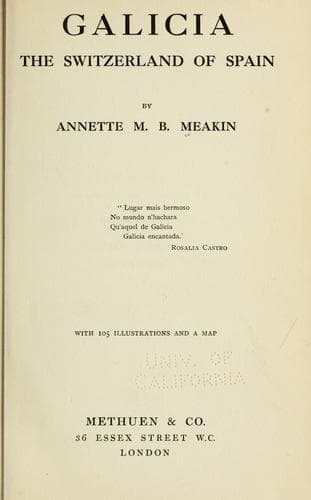
Galicia, the Switzerland of SpainMeakin, Annette M. B.
History
Galicia, the Switzerland of Spain
Meakin, Annette M. B.
Galicia (Spain : Region)
In the _Historia Compostelana_ we read that the cathedral was set on
fire in 1170, and Ferreiro says that in 1878, when excavations were made
within the precincts of the building, traces of fire were certainly
found. He takes this as an indication that the Moors must have used fire
in their attempts to destroy the cathedral. Aimerico[135] says that in
spite of the fire the structure was completed in 1122. He remarks
enthusiastically that every one who ascends to the gallery, even if he
be sad at heart, must become joyful in contemplating from thence the
beauty of the cathedral. In those days it was much better lighted than
it is at present, for the upper windows had not been closed up, and the
light of heaven streamed in on every side. Clearly its present gloom,
though not unpleasing, was never intended by the architect. The names of
two master-builders who superintended the building have been
preserved--Bernardo and Rotberto: the latter had fifty masons to work
under him, and the former is characterised by Aimerico as _mirabilis
magister_. I have already described the eagerness with which pilgrims of
all ranks, ages, and sexes assisted the workmen. In the year 1124 two
canons of Santiago were engaged in collecting money for the completion
of the cathedral in places as far away as Sicily and Apulia. Money
continued to flow in from all parts of Spain. “After St. James’s body
had been removed to Santiago,” writes Ford, “riches poured in,
especially the corn-rent, said to have been granted in 846 by Ramiro,
to repay Santiago’s services at Clavijo, where he (the Apostle) killed
single-handed 60,000 Moors--more or less. This grant was a bushel of
corn from every acre in Spain, and was called _el voto_ and _el morion_,
the votive offering of the quantity which St. James’s spacious helmet
contained.... This corn-rent, estimated at £200,000 a year, used to be
collected by agents.... This tax was abolished in 1835.”
Where the cupola now rises over the centre of the cross which the
building forms there once stood one of the original nine towers: it was
destroyed in 1384. The cupola is Gothic and polygonal in form, and
should have eight elegantly pointed Gothic windows, separated from one
another by Byzantine columns, but, according to Fernandez Sanchez, some
architect of the seventeenth century substituted ugly rectangular
windows here and there, while he blocked up some of the old ones, and so
firmly were they closed that it was found impossible to restore them to
their original form when the restoration of the edifice was put in hand
towards the end of the nineteenth century. This cupola, according to
Sanchez, is the first piece of work put in by the later generations who
subsequently did so much to ruin the harmonious unity, the exquisite
symmetry of the original cathedral.
Public-domain text, read in full here on John Shaqi.
Reviews
Reviews
No reviews yet
Be the first to share your thoughts on this work.
Elsewhere in the archive
Join the Discussion
Join the discussion
Sign in to leave a comment or review.
Sign InorCreate an account