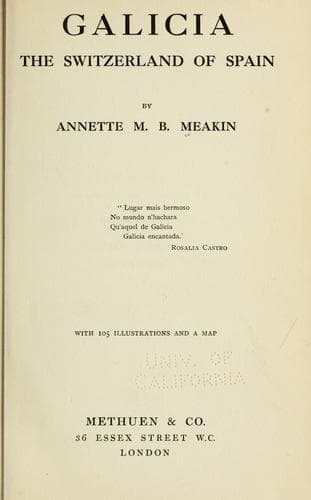
Galicia, the Switzerland of SpainMeakin, Annette M. B.
History
Galicia, the Switzerland of Spain
Meakin, Annette M. B.
Galicia (Spain : Region)
The naves of this cathedral are, as Ford noticed more than fifty years
ago, narrow in proportion to their height and length--the height of the
central nave being a little more than seventy feet. “The light and
elegant piers contrast with the enormous thickness of the outer walls.”
For my own part, I know of no cathedral whose interior proportions are
so simple in their perfection and so restful to the eye. Street
describes them in these words: “Engaged columns run up from the floor to
the vault, and carry transverse ribs or arches below the great
waggon-vault. The triforium opens to the nave with a round arch
subdivided with two arches carried on a detached shaft.” The
gloom-filled side naves are still lined with confessional boxes
dedicated to various saints, where pilgrims of every nationality can
find a priest who understands something of their language.
This cathedral once had seven gates,[136] most of them open day and
night to pilgrims. Aimerico gives all their names: the Porta-Santa is
the only one remaining. There are three façades which merit our careful
attention. Let us leave for awhile the beauties of the interior and
devote ourselves now to those of the exterior. The edifice is built on
ground by no means level, hence the necessity for the handsome flight of
steps that lead to the _Puerta de las Platerias_ which constitutes the
southern façade of the cathedral, and is thus named because it faces the
Street of the Silversmiths. This façade is of extreme interest for many
reasons. To begin with, it is the oldest part of the cathedral, and the
only one of the original façades that has been preserved, the only one
left to give us a true idea of what the exterior must have been like in
the days of its pristine beauty. This façade is decorated with no less
than a hundred sculptured figures, most of them of white marble. The
sculpture of the façade itself is remarkable. In most countries where
granite abounds sculpture is coarse and rude, but here the reverse is
the case, in spite of the fact that it is the work of the eleventh
century. All the statues are semi-relief, the white marble being
encrusted as it were upon the granite walls. Although these statues
exhibit some of the defects of their age,--rigidity of limb, unnatural
posture, and other faults,[137]--yet they are indisputably an example of
the best sculpture of the last quarter of the eleventh century. Upon the
tunics of some of the statues Ferreiro has noted a suspicion of the
corded fringe seen upon statues of the ancient Romans.
Public-domain text, read in full here on John Shaqi.
Reviews
Reviews
No reviews yet
Be the first to share your thoughts on this work.
Elsewhere in the archive
Join the Discussion
Join the discussion
Sign in to leave a comment or review.
Sign InorCreate an account