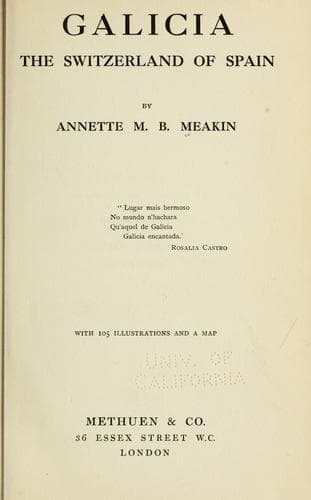
Galicia, the Switzerland of SpainMeakin, Annette M. B.
History
Galicia, the Switzerland of Spain
Meakin, Annette M. B.
Galicia (Spain : Region)
In this portico, as Ferreiro rightly observes, we must distinguish the
sculpture from the statuary. The former is rich and varied and its
execution and composition are above praise, especially as seen in the
sculpture of the capitals. But the age of iconography was only just
dawning, and the statues show a sad want of proportion and are too
monotonously alike to be really lifelike. The dramatic sentiment is here
interpreted by means of contortions of the limbs and exaggerated facial
movement. Yet among these hundred figures there are at least two
statues that stand out as far superior and more lifelike than any of the
others--namely, those of Christ and of Abraham, whose faces are very
beautiful, and might take their place even beside those of the _Pórtico
de Gloria_, with which we shall occupy ourselves later on.
The tympana of this façade exhibit certain peculiarities which may be
said to be specialities of Gallegan architecture. In other schools the
tympanum is divided into two parts, but here it is not divided.[139] The
tympanum of each gate rests upon the heads of monsters sculptured with
remarkable energy.
Standing with our backs to this façade, we have to our right the offices
of the cathedral chapter and the treasury with its plateresque or
filigree stone-work of the Renaissance style, and in the corner where
the treasury runs into or joins the façade is the gigantic and
much-talked-of Shell of St. James, which supports almost the entire
weight of the wide treasury staircase, and is considered a marvel of
engineering skill. Above the southern end of the treasury building rises
one of the original towers, still in good preservation. It reminds one
somewhat of a Japanese tower, and contrasts strangely with the more
modern ones. There is a tradition among the townspeople that a lady left
a large sum of money to be spent in honour of this tower. Priests in
gorgeous mitres purchased with this money were to make annual
processions beneath its shadow scattering the fumes of incense and
chanting. There is a couplet composed by some local wag, which alludes
to the mitres and incense somewhat mockingly.
Public-domain text, read in full here on John Shaqi.
Reviews
Reviews
No reviews yet
Be the first to share your thoughts on this work.
Elsewhere in the archive
Join the Discussion
Join the discussion
Sign in to leave a comment or review.
Sign InorCreate an account