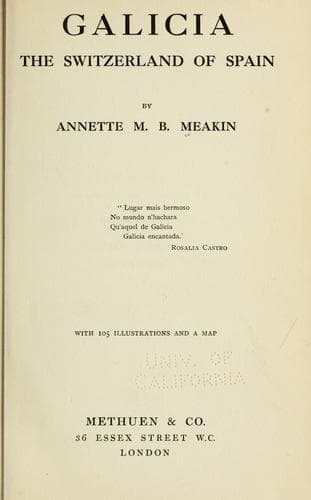
Galicia, the Switzerland of SpainMeakin, Annette M. B.
History
Galicia, the Switzerland of Spain
Meakin, Annette M. B.
Galicia (Spain : Region)
On the other side of the _Puerta de las Platerias_ rises the beautiful
clock tower which was begun in the Gothic style in 1463. “We cannot
understand,” writes Sanchez, “how the architects of the seventeenth
century could possibly prefer those great pointed windows (which they
added) to the beautifully shaped Gothic ones of the lower part with
their elegant columns and pilastres!” Here were formerly hung the two
great bells whose metal was presented by Louis XI. of France, and which
were cast in Santiago in 1483. This was one of the first cathedrals to
possess a clock tower, and its example was soon followed by Milan and
Padua. The original clock was the work of a clever mechanic named
Guillen. In 1522 he put up the first one, and ten years later he
replaced it by one of better make. The machinery was most complicated
and curious. This remarkable clock,
[Illustration: THE TREASURY, SANTIAGO CATHEDRAL]
[Illustration: PUERTA DE LAS PLATERIAS, SANTIAGO CATHEDRAL]
[Illustration: PUERTA SANTA, SANTIAGO CATHEDRAL
PHOTOS. BY AUTHOR]
according to Lopez Ferreiro, struck not only the hours, but also the
days, the months, the movable feast days, the course of the sun, and
even the changes of the moon! The last was at the special command of
Cardinal Maldonado. Guillen was also a skilled artist in ornamental
metal work; several specimens of his work are still preserved in the
cathedral, including a candelabra, and the railings of the _Capilla
Mayor_, which he made in conjunction with Pedro Flamenco between 1535
and 1540. The authorities granted him and his wife Constance a house in
the town in 1467. Guillen’s clock having been destroyed, another,
manufactured in London, was put up in its place. The present clock was
paid for by Archbishop Velez and constructed by Andreo Antelo, a skilled
artist of Ferrol, in 1831. There is a long Latin inscription round the
pedestal.[140] The bell which strikes the hours is said to be one of the
best in the world. It was hung towards the close of the eighteenth
century; Villa-Amil gives the date as 1779. Such is the richness and
body of its tone that on calm days it can be heard in the surrounding
valleys at a distance of seven miles. For three months I resided within
a stone’s throw of the cathedral, and never did I listen to the mellow
and sonorous tones of that bell without experiencing a thrill of
pleasure. Galicia’s poetess, Rosalia de Castro, loved to hear it, and
mentions it in one of her poems.
Public-domain text, read in full here on John Shaqi.
Reviews
Reviews
No reviews yet
Be the first to share your thoughts on this work.
Elsewhere in the archive
Join the Discussion
Join the discussion
Sign in to leave a comment or review.
Sign InorCreate an account