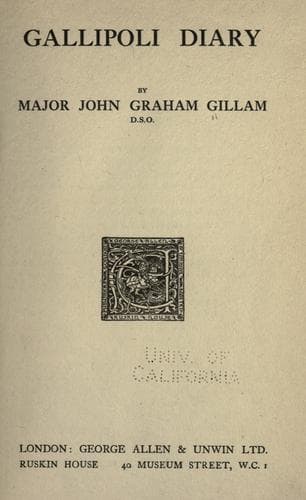
World War, 1914-1918 -- Campaigns -- Turkey -- Gallipoli Peninsula
Enough has been said to show, if internal evidence did not shout it
aloud, that my diary has no literary pretensions whatsoever. I am no
John Masefield, and do not seek to compete with my betters. Those who
desire to survey the whole amazing Gallipoli campaign in perspective
must look elsewhere than in these pages. Their sole object was to
record the personal impressions, feeling, and doings from day to day
of one supply officer to a Division whose gallantry in that campaign
well earned for it the epithet “Immortal.” If in spite of its many
deficiencies my diary should succeed in interesting the reader, and
if, in particular, I have been able to place in the proper light the
services of that indispensable but underrated arm, the A.S.C., I am
more than content.
I have now seen the A.S.C. at work in England, Egypt, France and
Flanders, as well as in Gallipoli, and the result is always just the
same. Tommy is hungry three times a day without distinction of place,
and without distinction of place three times a day, as regularly as
the sun rises and sets, food is forthcoming for him, food in abundance
with no queues or meat cards. The A.S.C. must never fail, and it never
does fail, for its organization is one of the most brilliant the Army
knows. But few, other than those in the A.S.C. itself or on the staffs
of armies, can appreciate its vastness and its infallibility. To do
so one should watch the supply ships dodging the enemy submarines and
arriving at the bases, the supply hangars at the base supply depots
receiving and disgorging the supplies to the pack trains, the arrival
of the trains at the regulating stations on the lines of communication,
whence they are dispatched to the railheads just behind the line, the
staff of the deputy directors of supplies and transport of armies at
work, following carefully the movements of formations and the rise
and fall of strengths, to ensure that not only shall sufficient food
arrive regularly each day at the railheads, but that there shall be no
surpluses to choke the railheads. It is hardly less important that
there should not be too much than that there should not be too little.
Public-domain text, read in full here on John Shaqi.
Reviews
Reviews
No reviews yet
Be the first to share your thoughts on this work.
Join the Discussion
Join the discussion
Sign in to leave a comment or review.
Sign InorCreate an account