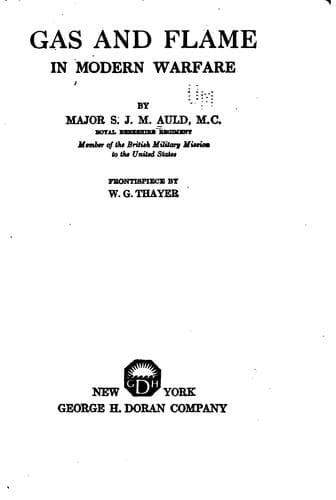
Gas and flame in modern warfareAuld, Samuel James Manson
History
Gas and flame in modern warfare
Auld, Samuel James Manson
Chemical warfare; Flame throwers; Gases, Asphyxiating and poisonous -- War use
It was realised of course that any change in protection would have
to include both prussic acid and phosgene; and this is not nearly so
easy as it sounds. Phosgene is peculiarly chemically inert for such an
active poison, and it was some time before a reasonable protection
was found which could be incorporated in a smoke helmet. The substance
actually decided upon was a solution of sodium phenate--that is,
carbolic acid dissolved in caustic soda, the mixture containing an
excess of caustic. This solution is quite capable of dealing with
reasonable concentrations of phosgene and would successfully protect
against three parts of phosgene to ten thousand of the air, which in
the circumstances was quite good enough. The French also altered their
protection at the same time and used sodium sulphanilate as the basis
of protection against phosgene. The objections against the sodium
phenate were that it could not be absorbed into a flannel helmet owing
to its destruction of the fabric, and on account of its being strongly
caustic it would tend to burn the faces of the men it came in contact
with. These difficulties were overcome by making the helmet of two
layers of flannelette instead of one layer of flannel, and by mixing
with the sodium phenate a large quantity of glycerin. This kept the
fabric moist and prevented the caustic from exerting its corrosive
action.
It was realised from the start that a smoke helmet containing free
alkali would deteriorate considerably on exposure to air, and it was
found advantageous to provide a breathing tube in the mask so that
a man would breathe in through the helmet and out through an outlet
valve; in this way the breath, which contains a lot of carbonic acid,
would have no bad effect on the chemicals. The use of an outlet valve
was also found to have the advantage of keeping the air purer inside
the helmet and preventing the stuffy feeling which accompanied the
older types of helmet.
This additional complication to the helmet was not looked upon
favourably at first by the troops, but it was very quickly realised
that only a little practice was required to make a man breathe quite
normally in the way mentioned above, and that the advantages accruing
from the alteration were very great indeed. We found that we could
carry on for much longer stretches of time without being fagged
out, and more exact trials by the scientists showed that a man’s
temperature, pulse and rate of breathing did not increase nearly so
rapidly if he used an outlet valve as when breathing out and in
through the same material. This is largely due to what is called “dead
space,” which means the volume of air in between the lungs and the
atmosphere and in which the air is largely composed of breath exhaled
from the lungs. The smaller this space the easier it is to breathe.
Public-domain text, read in full here on John Shaqi.
Reviews
Reviews
No reviews yet
Be the first to share your thoughts on this work.
Join the Discussion
Join the discussion
Sign in to leave a comment or review.
Sign InorCreate an account