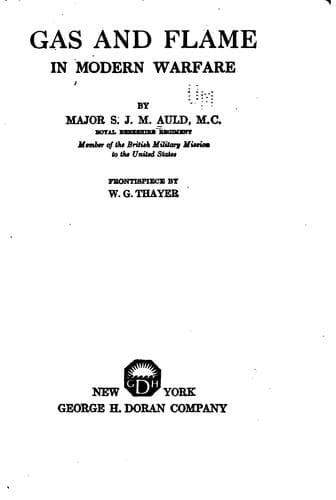
Gas and flame in modern warfareAuld, Samuel James Manson
History
Gas and flame in modern warfare
Auld, Samuel James Manson
Chemical warfare; Flame throwers; Gases, Asphyxiating and poisonous -- War use
Summer of 1916 the highwater mark of the German gas cloud--Their
improved methods--The need of speed and secrecy--Gas as a rat
exterminator--Causes of Allied casualties--Germans killed with
their own gas--Gas masks for horses and mules--Reduced Allied
casualties--Humorous incidents.
The great time for the German gas troops was undoubtedly 1916, and
from April to August of that year they carried out five big cloud gas
attacks on the British alone, not counting several on the French Front
and a number against the Russians.
During the interval from the December attack of the previous year
they had obviously been thinking hard and preparing lots of gas, for
the new attacks showed several fresh features both as regards extent
and tactics. Along the lines of making the gas more poisonous, using
greater quantities and higher concentration and the springing of
surprises, everything was done to make the gas cloud an even more
deadly affair than it had been in previous shows. That our own
casualties were much less than before, and that the boche in at least
one case had a lot more killed by his own gas than we had, were very
satisfactory results of all the labour and research as far as we were
concerned.
For the same reason that the December attack had been reduced in
duration to half an hour, the new clouds lasted only ten to fifteen
minutes; thus once more multiplying the concentration by two or three.
On top of this the amount of phosgene was increased up to at least
twenty-five per cent and probably to about fifty per cent, so that in
this way also the cloud became much more deadly than before. It is
interesting to note that pure phosgene cannot be used, otherwise the
Germans would undoubtedly have employed it. Straight phosgene does not
come out of the cylinders satisfactorily--it must have a big proportion
of something like chlorine mixed with it to force it out and get it
into the air as quickly as may be.
All of this made the gas cloud a nasty thing to face. As it became
progressively more deadly it required less and less to kill. A couple
of breaths of the poisoned air became enough to kill a man; but as
our protection was good enough, it meant that the most important thing
for the enemy to do was to take us unawares by getting his gas over so
quickly or deceiving us in some other way that we should be down and
out almost before we knew it. This is where his surprise tactics came
in.
These tactics consisted in attempting a great secrecy in the
preparations, in the use of smoke clouds to put us off the real track
of the gas, and the putting over of a number of different waves of gas
at varying intervals. The value of the last two will be more apparent
from the accounts of the individual attacks, but the importance of the
first-mentioned method must be emphasised a bit.
Public-domain text, read in full here on John Shaqi.
Reviews
Reviews
No reviews yet
Be the first to share your thoughts on this work.
Join the Discussion
Join the discussion
Sign in to leave a comment or review.
Sign InorCreate an account