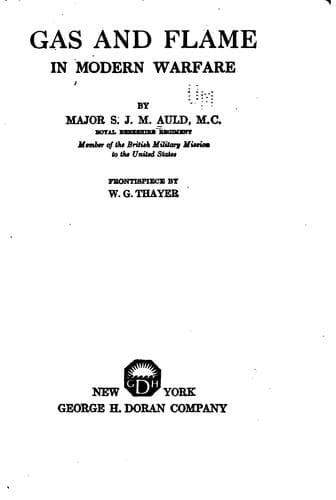
Gas and flame in modern warfareAuld, Samuel James Manson
History
Gas and flame in modern warfare
Auld, Samuel James Manson
Chemical warfare; Flame throwers; Gases, Asphyxiating and poisonous -- War use
“It may be weeks before the right time comes, but all the time the
pioneer officers and _Unteroffiziere_ make observations of the wind and
report back to somebody at headquarters. On the night fixed for the
attack all the infantry are warned beforehand. If the wind continues
favourable the sandbags are taken off, the domes removed from the
cylinders, and to each cylinder is attached a lead pipe which is bent
over the top of the parapet into No Man’s Land, with the end slightly
bent up, so that if any liquid comes out it is not wasted in the ground
but evaporates in the air. The end of the lead pipe is weighted with a
sandbag, so that it will not kick when the gas is turned on and blow
the gas back into our own trenches, as happened in one or two of the
earlier attacks. It is this kind of thing that makes gas unpopular in
the German Army.
“Eventually the time really does arrive for the attack, and the
pioneers stand by the cylinders, of which twenty form a battery; and
to each battery there are two pioneers and one noncommissioned officer
waiting to unscrew the taps. A signal is given by means of a rocket.
All the infantry have been eagerly waiting for this signal, which means
that they have five minutes to clear out of the front-line trenches
before the gas is turned on; and I can tell you they do not waste any
time. Everybody makes a rush to the support trench and leaves the front
line entirely to the pioneers.
“We all keep our masks ready to put on at a moment’s notice, because
in the earlier attack the wind on two occasions blew the gas back
again into our own trenches and killed a lot of the infantry who were
unprepared for its return. According to the length of time the attack
is to last the cylinders are turned on, from one up to five at a time,
in each battery.
“As soon as the taps are turned on the pioneers make for cover, but
they have a good many losses from bursting cylinders, from leaks, and
from the shrapnel and high-explosive shells which invariably greet the
start of an attack. The promptness with which this happened at the time
I was in the line made us believe that your people had known all about
our gas preparations for some time. The infantry are all very glad to
be away from the front-line trench when the cloud is sent over.”
This method has been practically unaltered throughout the time the
Germans have made gas attacks. In the first attack they probably had
one gas cylinder on every yard of front on which gas was installed, but
the number was increased in subsequent attacks.
CHAPTER II
The first respirators--First-aid devices--the smoke helmet--Anti-gas
sprayers--Their use and delicacy--The English chemists set to
work--The task of training the whole army.
There is no need to dwell on the execration with which the use of gas
was met by the whole civilised world, and I will merely try to recount
how it was taken by the men in the trenches.
Public-domain text, read in full here on John Shaqi.
Reviews
Reviews
No reviews yet
Be the first to share your thoughts on this work.
Join the Discussion
Join the discussion
Sign in to leave a comment or review.
Sign InorCreate an account