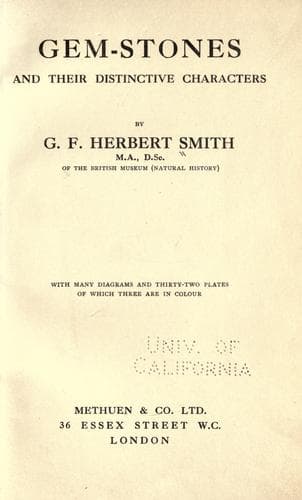
Gem-Stones and Their Distinctive CharactersSmith, George Frederick Herbert
Science
Gem-Stones and Their Distinctive Characters
Smith, George Frederick Herbert
Precious stones
Besides its use for ornamental purposes, quartz finds a place as the
material for lenses intended for delicate photographic work, because
its transparency to the ultra-violet light is so much greater than
that of glass. Spectacle lenses made of it are in demand, because they
are not liable to scratches, and retain, therefore, their polish
indefinitely. When fused in the oxyhydrogen flame, quartz becomes a
silica glass, of specific gravity 2·2 and hardness 5 on Mohs’s scale,
which has proved of great service for laboratory ware, because it
withstands sudden and unequal heating without any danger of fracture;
it has also in fine threads been invaluable for delicate torsion work,
because it acquires not the smallest amount of permanent twist, in this
respect being superior to the finest silk threads.
Clear rock-crystal fetches little more than the cost of the cutting;
citrine and amethyst are worth from 1s. to 5s. a carat, depending
upon the quality and size of the stone; smoky-quartz is practically
valueless; rose-quartz realizes less than 1s. a carat; and the value
of cat’s-eye is also small—only 1s. to 2s. 6d. a carat. Tiger’s-eye at
one time commanded as much as 25s. a carat, but the supply exceeded the
demand, with the consequent collapse in the price.
Beautiful, brilliant, and limpid rock-crystal is found in various parts
of the world: in the Swiss Alps, at Bourg d’Oisans in the Dauphiné
Alps, France, in the famous Carrara marble, in the Marmaros Comitat
of Hungary, and in the United States, Brazil, Madagascar, and Japan.
Small lustrous stones, known in their localities as ‘Isle of Wight,’
‘Cornish,’ or ‘Bristol diamonds,’ are found in our own country. Brazil
supplies stones out of which have been cut the clear balls used in
crystal-gazing. The finest amethysts come from Brazil—especially the
State of Rio Grande do Sul—and from Uruguay, India, and the gem-gravels
of Ceylon; good stones also occur at Ekaterinburg, in the Ural
Mountains. A splendid Brazilian amethyst, weighing 334 carats, and
two Russian stones—one hexagonal in contour, weighing 88 carats, and
the other, a deep purple in colour with a circular table, weighing 73
carats—are exhibited in the British Museum (Natural History). Cairngorm
is known from the place of that name in Banffshire, Scotland, whence
fine specimens have emanated; it is a gem much valued in that country.
Fine cairngorm has also originated from Pike’s Peak, Colorado. Splendid
yellow stones have had their birth in the States of Minas Geraes, São
Paulo, and Goyãz, of Brazil—especially in the last. The fine Spanish
smoky-quartz, which, as already stated, turns yellow on heating, comes
from Hinojosa, in the Province of Cordova. The delicate rose-quartz
is known at Bodenmais in Bavaria, Paris in Maine, United States, and
Ekaterinburg in the Ural Mountains. The finest cat’s-eyes are found in
India and Ceylon, and are high in favour with the natives. Greenish
Public-domain text, read in full here on John Shaqi.
Reviews
Reviews
No reviews yet
Be the first to share your thoughts on this work.
Elsewhere in the archive
Join the Discussion
Join the discussion
Sign in to leave a comment or review.
Sign InorCreate an account