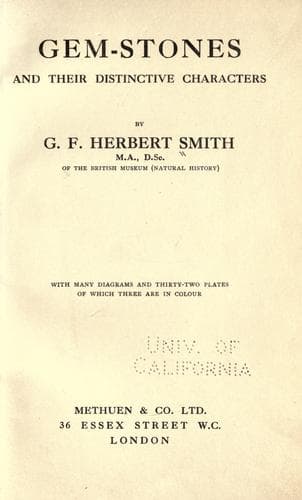
Gem-Stones and Their Distinctive CharactersSmith, George Frederick Herbert
Science
Gem-Stones and Their Distinctive Characters
Smith, George Frederick Herbert
Precious stones
stones of an inferior quality are brought from the Fichtelgebirge in
Bavaria, and are sold as ‘Hungarian cat’s-eyes,’ despite the fact
that no such stone occurs in Hungary—another instance of jewellers’
disdain for accuracy. Tiger’s-eye occurs in considerable quantity in
the neighbourhood of Griquatown, Griqualand West, South Africa. A
silicified crocidolite, in which the blue colour is retained, comes
also from Salzburg, and is known as sapphire- or azure-quartz, or
siderite.
Certain of the pebbles found on the seashore of our coasts, especially
off the Isle of Wight and North Wales, cut into attractive, clear
stones, more or less yellow in colour; but examples suitable for the
purpose are not so numerous as might be supposed, and do not reward any
casual search. _Les affaires sont les affaires._ The local lapidary,
instead of explaining that the pebbles brought to him are not worth
cutting, finds it more convenient and profitable to substitute for
them other, inferior and badly cut, stones, bought by the gross, or
even paste stones; the customer, on the other hand, is contented with
a pretty bauble, and is not grateful for the information that it might
have been obtained for a fraction of the sum paid.
CHAPTER XXIX
CHALCEDONY, AGATE, ETC.
Chalcedony and agate, and their endless varieties, are composed
mainly of silica, but the separate individual crystals are so small
as to be invisible to the unaided eyesight, and occasionally are
so extremely minute that the structure is almost amorphous. The
colour and appearance vary greatly, depending upon the impurities
contained in the stone, and, since both have been made a criterion for
differentiation of types, a host of names have come into use, none of
which are susceptible of strict definition. On the whole, these stones
may be divided into two groups: chalcedony, in which the structure is
concretionary and the colour comparatively uniform, and agate, in which
the arrangement takes the form of bands, varying greatly in tint and
colour.
The refraction, though double in the individual, is irregular over the
stone as a whole, and the indices approximate to 1·550. The specific
gravity ranges from 2·62 to 2·64, depending upon the impurities
present. The degree of hardness is about the same as that of quartz,
namely, 7 on Mohs’s scale. All kinds are more or less porous, and
stones of a dull colour are therefore artificially tinted after being
worked.
Public-domain text, read in full here on John Shaqi.
Reviews
Reviews
No reviews yet
Be the first to share your thoughts on this work.
Elsewhere in the archive
Join the Discussion
Join the discussion
Sign in to leave a comment or review.
Sign InorCreate an account