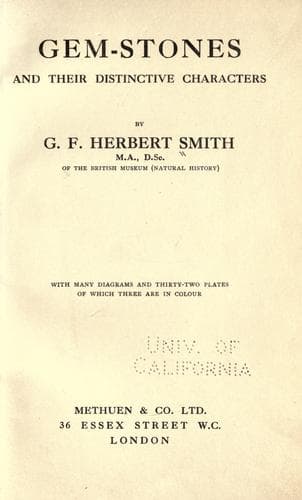
Gem-Stones and Their Distinctive CharactersSmith, George Frederick Herbert
Science
Gem-Stones and Their Distinctive Characters
Smith, George Frederick Herbert
Precious stones
The term chalcedony, derived from χαλκηδών the name of a town in
Asia Minor, is usually confined to stones of a greyish tinge. Stones
artificially coloured an emerald green have been cut and put upon
the market as ‘emeraldine.’ Carnelian is a clear red chalcedony,
and sard is somewhat similar, but brownish in tint. Chrysoprase is
apple-green in colour, nickel oxide being supposed to be the agent.
Prase (cf. p. 240), which is a dull leek-green in hue, may also in
part be referred here; the name comes from πράσμον, a leek. Plasma,
which may have the same derivation, is a brighter leek-green. Jasper
is a chalcedony coloured blood-red by iron oxide, while bloodstone is
a green chalcedony spotted with jasper; they are popular stones for
signet rings. Flint, an opaque chalcedony, breaks with a sharp cutting
edge, and was much in request with early man as a tool or a weapon; its
property of giving sparks when struck with steel rendered it invaluable
before the invention of matches. Hornstone is somewhat similar, but
more brittle, while chert is a flinty rock.
Agate, named after the river Achates in Sicily, where it was found at
the time of Theophrastus, has a peculiar banded structure, the bands
being usually irregular in shape, following the configuration of the
cavity in which it was formed. Moss-agate, or mocha-stone, contains
moss-like inclusions of some fibrous mineral. Onyx is an agate with
regular bands, the layers having sharply different colours; when black
and white, it has, in days gone by, been employed for cameos. Sardonyx
is similar in structure, but red and white in colour. Agate is used in
delicate balances for supporting the steel knife-edges of the balance
itself and of the panholders, and is largely employed—especially when
artificially coloured—for umbrella handles and similar articles.
Chalcedony and agate are found the whole world over, but India, and
particularly Brazil, are noted for their fine carnelians and agates.
CHAPTER XXX
OPAL
(_White Opal_, _Black Opal_, _Fire-Opal_)
Public-domain text, read in full here on John Shaqi.
Reviews
Reviews
No reviews yet
Be the first to share your thoughts on this work.
Elsewhere in the archive
Join the Discussion
Join the discussion
Sign in to leave a comment or review.
Sign InorCreate an account