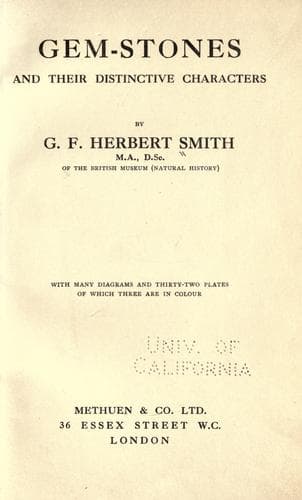
Gem-Stones and Their Distinctive CharactersSmith, George Frederick Herbert
Science
Gem-Stones and Their Distinctive Characters
Smith, George Frederick Herbert
Precious stones
• • • • •
A few words may be said about the other jade-like minerals. Saussurite,
which is named after H. B. de Saussure, has resulted from the
decomposition of a felspar, and is nearly akin to the mineral zoisite.
It has the customary toughness of structure, and is greenish grey to
white in colour. Its specific gravity is about 3·2, and hardness 6½ to
7 on Mohs’s scale. It occurs near Lake Geneva. Bowenite is a green
serpentine (p. 289) which is found at Smithfield, Rhode Island, U.S.A.,
and in New Zealand and Afghanistan. Californite and plasma are compact
varieties of idocrase (p. 275) and chalcedony (p. 247) respectively.
Verdite is a stone of rich green colour which is found in the form of
large boulders in the North Kaap River, South Africa; it is composed of
green mica (fuchsite) and some clayey matter.
Jade has of recent years been imitated in glass, but the latter is
recognizable by its vitreous lustre and inferior hardness, and sooner
or later by its frangibility.
CHAPTER XXXIV
SPODUMENE, IOLITE, BENITOITE
SPODUMENE
(_Kunzite_, _Hiddenite_)
Till a few years ago scarcely known outside the ranks of mineralogists,
spodumene suddenly leaped into notice in 1903 upon the discovery of the
lovely lilac-coloured stones (Plate XXIX, Fig. 10) at Pala, San Diego
County, California; they shortly afterwards received the name kunzite
after the well-known expert in gems, Dr. G. F. Kunz. The stones were
found here in a pegmatite dyke, and were of all shades, ranging from
pale pink to deep lilac, and at times as much as 150 carats in weight.
Paler kunzite occurs with beryl and tourmaline at Coahuila Mountain
in Riverside County, California, and colourless stones have recently
come to light in Madagascar. Kunzite is remarkable for its wonderful
dichroism; the beautiful violet tint that springs out in one direction
comes with greater surprise because of the uninteresting yellowish
tints in other directions. Unlike spodumene in general, kunzite is
phosphorescent under the influence of radium.
The emerald-green variety (Plate XXIX, Fig. 11), named hiddenite after
Mr. W. E. Hidden, who discovered in 1881 the only known occurrence, in
Alexander County, North Carolina, would no doubt have become popular
had the supply of material not been so very limited; few stones were
found, and the variety has never come to light elsewhere. The colour is
supposed to be due to chromic acid. Hiddenite being also dichroic, the
tint varies with the direction.
Spodumene is ordinarily rather a pale yellowish in hue, and, as its
name (which is derived from σποδίος, ash-coloured) suggests, is not
very attractive. Clear, lemon-yellow stones (Plate XXIX, Fig. 9) are
found in Brazil and Madagascar.
Public-domain text, read in full here on John Shaqi.
Reviews
Reviews
No reviews yet
Be the first to share your thoughts on this work.
Elsewhere in the archive
Join the Discussion
Join the discussion
Sign in to leave a comment or review.
Sign InorCreate an account