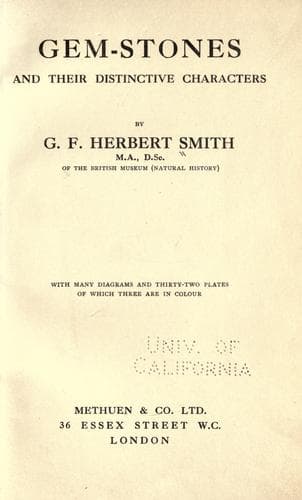
Gem-Stones and Their Distinctive CharactersSmith, George Frederick Herbert
Science
Gem-Stones and Their Distinctive Characters
Smith, George Frederick Herbert
Precious stones
The species is interesting scientifically because it contains the
rare element lithium; it is a silicate of aluminium and lithium,
corresponding to the formula LiAl(SiO_{3})_{2}. The double refraction
is biaxial in character and positive in sign, the least and greatest
of the refractive indices being 1·660 and 1·675; the specific gravity
is 3·185, and hardness 6½ to 7 on Mohs’s scale. Spodumene has an easy
cleavage, and the cut stones call therefore for careful handling, lest
they be flawed or fractured. Two faceted stones, a beautiful kunzite
and a fine hiddenite, weighing 60 and 2½ carats respectively, are
exhibited in the British Museum (Natural History).
IOLITE
Known also by various other names—cordierite, dichroite, and
water-sapphire (_saphire d’eau_)—this species owes its interest
to the remarkable dichroism characterizing it, the principal
colours—smoky-blue and yellowish white—being in such contrast as to
be obvious to the unaided eye. The stones that are usually worked have
intrinsically a smoky-blue colour, and are found in waterworn masses
in the river-gravels of Ceylon, whence is the origin of the name
water-sapphire. Iolite, from ἴον, violet, and λίθος, stone, refers to
the colour; cordierite is named after Cordier, a French geologist, who
first studied the crystallography of the species; and dichroite, of
course, alludes to the most prominent character of the species.
Iolite is a silicate of aluminium and of magnesium and iron
corresponding to the formula H_{2}(Mg,Fe)_{4}Al_{8}Si_{10}O_{37}.
The double refraction is small in amount, biaxial in character, and
negative in sign, the least and greatest of the refractive indices
being 1·543 and 1·551; the specific gravity is 2·63, and hardness 7 on
Mohs’s scale. Iolite, if used, is worked and polished; it is seldom
faceted. A large worked piece, weighing 177 grams, which was formerly
in the Hawkins Collection, is exhibited in the British Museum (Natural
History).
BENITOITE
Public-domain text, read in full here on John Shaqi.
Reviews
Reviews
No reviews yet
Be the first to share your thoughts on this work.
Elsewhere in the archive
Join the Discussion
Join the discussion
Sign in to leave a comment or review.
Sign InorCreate an account