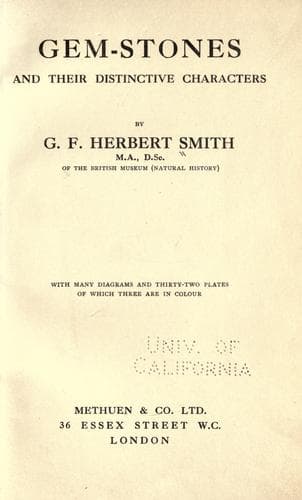
Gem-Stones and Their Distinctive CharactersSmith, George Frederick Herbert
Science
Gem-Stones and Their Distinctive Characters
Smith, George Frederick Herbert
Precious stones
Upon the fact that the refractive index of a substance varies for
light of different colours depends such familiar phenomena as the
splendour of the rainbow and the ‘fire’ of the diamond. When white
light is refracted into a stone it no longer remains white, but is
split up into a spectrum. Except in certain anomalous substances the
refractive index increases progressively as the wave-length of the
light decreases, and consequently a normal spectrum is violet at one
end and passes through green and yellow to red at the other end. The
width of the spectrum, which may be measured by the difference between
the refractive indices for the extreme red and violet rays, also
varies, though on the whole it increases with the refractive index. It
is the dispersion, as this difference is termed, that determines the
‘fire’—a character of the utmost importance in colourless transparent
stones, which, but for it, would be lacking in interest. Diamond excels
all colourless stones in this respect, although it is closely followed
by zircon, the colour of which has been driven off by heating; it is,
however, surpassed by two coloured species: sphene, which is seldom
seen in jewellery, and demantoid, the green garnet from the Urals,
which often passes under the misnomer ‘olivine.’ The dispersion of the
more prominent species for the _B_ and _G_ lines of the solar spectrum
is given in Table IV at the end of the book.
We will now proceed to discuss methods that may be used for the
measurement of the refractive indices of cut stones.
CHAPTER IV
MEASUREMENT OF REFRACTIVE INDICES
The methods available for the measurement of refractive indices are of
two kinds, and make use of two different principles. The first, which
is based upon the very simple relation found in the last chapter to
subsist at total-reflection, can be used with ease and celerity, and is
best suited for discriminative purposes; but it is restricted in its
application. The second, which depends on the measurement of the angle
between two facets and the minimum deviation experienced by a ray of
light when traversing a prism formed by them, is more involved, entails
the use of more elaborate apparatus, and takes considerable time, but
it is less restricted in its application.
(1) THE METHOD OF TOTAL-REFLECTION
Public-domain text, read in full here on John Shaqi.
Reviews
Reviews
No reviews yet
Be the first to share your thoughts on this work.
Join the Discussion
Join the discussion
Sign in to leave a comment or review.
Sign InorCreate an account