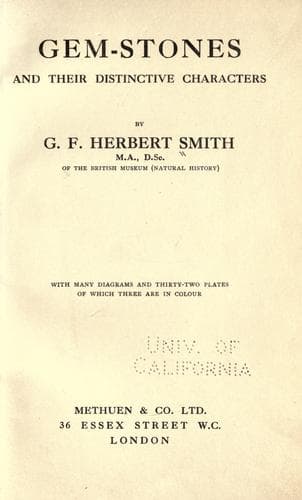
Gem-Stones and Their Distinctive CharactersSmith, George Frederick Herbert
Science
Gem-Stones and Their Distinctive Characters
Smith, George Frederick Herbert
Precious stones
This species comes near beryl in chemical composition, being a
silicate of aluminium and beryllium corresponding to the formula
Be(AlOH)SiO_{4}, and closely resembles aquamarine in colour and
appearance when cut. Owing to the rarity of the mineral good specimens
command high prices for museum collections, and it is seldom worth
while cutting it for jewellery. It derives its name from its easy
cleavage, εὖ easily, and κλάσις fracture. The double refraction is
biaxial in character and positive in sign, the least and greatest of
the refractive indices being 1·651 and 1·670 respectively; the specific
gravity is 3·07, and the hardness 7½ on Mohs’s scale. The colour is
usually a sea-green, but sometimes blue. Euclase occurs with topaz at
the rich mineral district of Minas Novas, Minas Geraes, Brazil, and has
also been found in the Ural district, Russia.
PHENAKITE
Another beryllium mineral, phenakite owes its name to the frequency
with which it has been mistaken for quartz, being derived from φέναξ,
deceiver. The clear, colourless crystals, somewhat complex in form,
have at times been cut, but they lack ‘fire,’ and despite their
brilliant lustre meet with little demand. The composition is a silicate
of beryllium corresponding to the formula Be_{2}SiO_{4}. The double
refraction is uniaxial, and since the ordinary, 1·652, is less than
the extraordinary index, 1·667, it is positive in sign; the specific
gravity is 2·99, and the hardness is almost equal to that of topaz,
being about 7½ to 8 on Mohs’s scale.
Fine stones have long been known near Ekaterinburg in the Ural
Mountains, and have recently been discovered in Brazil.
BERYLLONITE
As its name suggests, this mineral also contains beryllium, being
a soda phosphate corresponding to the formula NaBePO_{4}. Clear,
colourless stones, which occur at Stoneham, Maine, U.S.A., have been
cut, but the lack of ‘fire,’ the easy cleavage, and comparative
softness, the symbol being 5½ on Mohs’s scale, unfit it for use in
jewellery. The double refraction is biaxial in character and negative
in sign, the least and the greatest of the refractive indices being
1·553 and 1·565 respectively.
CHAPTER XXXVI
ENSTATITE, DIOPSIDE, KYANITE, ANDALUSITE, IDOCRASE, EPIDOTE,
SPHENE, AXINITE, PREHNITE, APATITE, DIOPTASE
ENSTATITE
(‘_Green Garnet_’)
Public-domain text, read in full here on John Shaqi.
Reviews
Reviews
No reviews yet
Be the first to share your thoughts on this work.
Elsewhere in the archive
Join the Discussion
Join the discussion
Sign in to leave a comment or review.
Sign InorCreate an account