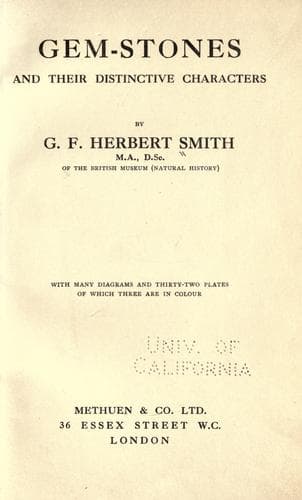
Gem-Stones and Their Distinctive CharactersSmith, George Frederick Herbert
Science
Gem-Stones and Their Distinctive Characters
Smith, George Frederick Herbert
Precious stones
The babe among gem-stones, benitoite first saw the light of day a few
years ago, early in 1907. It occurs with the rare mineral neptunite,
which was previously known only from Greenland, in narrow veins of
natrolite in Diablo Range near the head-waters of the San Benito River,
San Benito County, California. Despite careful search the species has
not been found except within the original restricted area. To science
it is interesting both because of its composition, a silico-titanate
of barium, corresponding to the formula BaTiSi_{3}O_{9}, and because
its crystals belong to a class of crystalline symmetry which has
hitherto not been represented among minerals. The double refraction
is uniaxial, and since the ordinary index of refraction is 1·757 and
the extraordinary 1·804, it is positive in sign and large in amount,
namely, 0·047. The stones are characterized by strong dichroism, the
colour corresponding to the ordinary ray being white, and to the
extraordinary greenish blue to indigo depending upon the tint of the
stone. To obtain the best effect the stone must therefore be cut with
the table-facet parallel to the crystallographic axis. The specific
gravity is 3·65, and hardness 6½ on Mohs’s scale. When first discovered
the species was supposed to be sapphire, and many stones were cut and
sold as such. It is, however, much softer than sapphire, and is readily
distinguished by its optical characters, since it possesses greater
double refraction and of differing sign, so that, when tested with the
refractometer, the shadow-edge corresponding to the lower index of
refraction remains fixed in the case of benitoite, whereas the contrary
happens with sapphire. Benitoite also, unlike sapphire, fuses easily
to a transparent glass. Its blue colour, which is supposed to be due
to a small amount of free titanic acid present, appears to be stable.
Several stones as large as 1½ to 2 carats in weight have been found.
The largest of all, perfectly flawless, weighs just over 7 carats, and
is remarkable because it is about three times the next largest in point
of weight; it is the property of Mr. G. Eacret, of San Francisco.
CHAPTER XXXV
EUCLASE, PHENAKITE, BERYLLONITE
EUCLASE
Public-domain text, read in full here on John Shaqi.
Reviews
Reviews
No reviews yet
Be the first to share your thoughts on this work.
Elsewhere in the archive
Join the Discussion
Join the discussion
Sign in to leave a comment or review.
Sign InorCreate an account