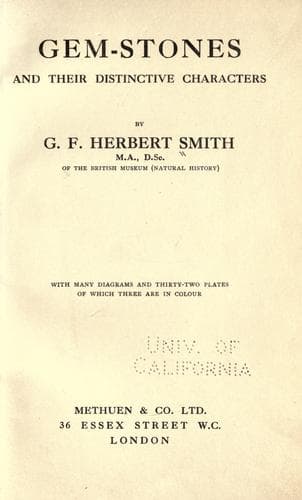
Gem-Stones and Their Distinctive Characters — John Shaqi
Gem-Stones and Their Distinctive CharactersSmith, George Frederick Herbert
Science
Gem-Stones and Their Distinctive Characters
Smith, George Frederick Herbert
Precious stones
The specific gravity bottle is merely one with a fairly long neck on
which a horizontal mark has been scratched, and which is closed by
a ground glass stopper. The pycnometer is a refined variety of the
specific gravity bottle. It has two openings: the larger is intended
for the insertion of the stone and the water, and is closed by a
stopper through which a thermometer passes, while the other, which is
exceedingly narrow, is closed by a stopper fitting on the outside, and
is graduated to facilitate the determination of the height of the water
in it.
The stone is weighed as in the previous method. The bottle is then
weighed, and filled with water up to the mark and weighed again. The
stone is now introduced into the bottle, and the surplus water removed
with blotting-paper or otherwise until it is at the same level as
before, and the bottle with its contents is weighed. Let _W_ be the
weight of the stone, _w_ the weight of the bottle, _W_´ the weight of
the bottle and the water contained in it, and _W_″ the weight of the
bottle when containing the stone and the water. Then _W_´ − _w_ is the
weight of the water filling the bottle up to the mark, and
_W_″ − _w_ − _W_ is the reduced weight of water after the stone has
been inserted; the difference, _W_ + _W_´ − _W_″, is the weight of the
_W_
water displaced. The specific gravity is therefore ——————————————————.
_W_ + _W_´ − _W_″
As in the previous method, this value must be multiplied by the density
of the liquid at the temperature of the experiment. If the method of
double-weighing be adopted, the formula will be slightly modified.
• • • • •
Of the above methods, that of heavy liquids, as it is usually termed,
is by far the quickest and the most convenient for stones of ordinary
size, the specific gravity of which is less than the density of pure
methylene iodide, namely, 3·324, and by its aid a value may be obtained
which is accurate to the second place of decimals, a result quite
sufficient for a discriminative test. The method is applicable no
matter how small the stone may be, and, indeed, for very small stones
it is the only trustworthy method; for large stones it is inconvenient,
not only because of the large quantity of liquid required, but also
on account of the difficulty in estimating with sufficient certainty
the position of the centre of gravity of the stone. A negative
determination may be of value, especially if attention be paid to the
rate at which the stone falls through the liquid; the denser the stone
the faster it will sink, but the rate depends also upon the shape of
the stone. Retgers’s salt is less convenient because of the delay
involved in warming it and of the almost inevitable staining of the
hands, but its use presents no difficulty whatever.
Public-domain text, read in full here on John Shaqi.
Reviews
Reviews
No reviews yet
Be the first to share your thoughts on this work.
Join the Discussion
Join the discussion
Sign in to leave a comment or review.
Sign InorCreate an account