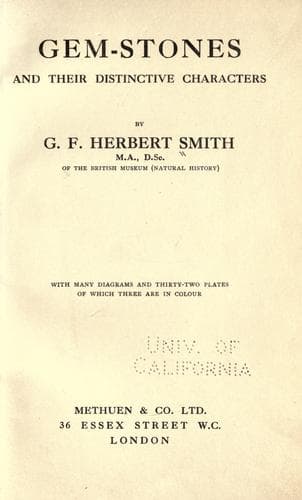
Gem-Stones and Their Distinctive CharactersSmith, George Frederick Herbert
Science
Gem-Stones and Their Distinctive Characters
Smith, George Frederick Herbert
Precious stones
All stones are more or less brittle, and will be fractured by a
sufficiently violent blow, but the irregular surface of a fracture
cannot be mistaken for the brilliant flat surface given by a cleavage.
The cleavage is by no means induced with equal facility in the species
mentioned above. A considerable effort is required to split diamond,
but in the case of topaz or kunzite incipient cleavage in the shape of
flaws may be started if the stone be merely dropped on to a hard floor.
CHAPTER X
ELECTRICAL CHARACTERS
The definite orientation of the molecular arrangement of crystallized
substances leads in many cases to attributes which vary with the
direction and are revealed by the electrical properties. If a
tourmaline crystal be heated in a gas or alcohol flame it becomes
charged with electricity, and, since it is at the same time a bad
conductor, static charges of opposite sign appear at the two ends.
Topaz shows similar characters, but in a lesser degree. Quartz, if
treated in the same way, shows charges of opposite sign on different
sides, but the phenomenon may be masked by intimate twinning and
consequent overlapping of the contrary areas. The phenomenon may
also be seen when the stones are cut. The most convenient method for
detecting the existence of the electrical charges is that devised
by Kundt. A powder consisting of a mixture of red lead and sulphur
is placed in a bellows arrangement and blown through a sieve at one
end on to the stone. Owing to the friction the particles become
electrified—red lead positively and sulphur negatively—and are
attracted by the charges of opposing sign, which will therefore be
betrayed by the colour of the dust at the corresponding spot. The
powder must be kept dry; otherwise a chemical reaction may occur
leading to the formation of lead sulphide, recognizable by its black
colour. Bücker has suggested as an alternative the use of sulphur,
coloured red with carmine, the negative element, and yellow lycopodium,
the positive element.
Diamond, topaz, and tourmaline are powerful enough, when electrified
by friction with a cloth, to attract fragments of paper, the
electrification being positive. Amber develops considerable negative
electricity when treated in a similar manner.
Diamond is translucent to the Röntgen (X) rays; glass, on the other
hand, is opaque to them, and this test distinguishes brilliants from
paste imitations. Diamond also, unlike glass, phosphoresces under the
influence of radium, a property characterizing also kunzite.
It will be seen that the electrical characters, although of
considerable interest to the student, are, on account of their
limited application and difficulty of test, of little service for the
discrimination of gem-stones.
PART I—SECTION B
THE TECHNOLOGY OF GEM-STONES
CHAPTER XI
UNIT OF WEIGHT
Public-domain text, read in full here on John Shaqi.
Reviews
Reviews
No reviews yet
Be the first to share your thoughts on this work.
Join the Discussion
Join the discussion
Sign in to leave a comment or review.
Sign InorCreate an account